Movement is the essence of life

I’ve been inspired recently by running, particularly runners that take off through the woods and trails and run for hours. They seem connected and plugged in to the earth somehow. I’m not a runner, but their endeavours inspire me on a whole number of levels.

I’d like to share this great video, Why We Run, which is one of a number of other great videos in that series. They really strikes at the heart of many themes I’ve been ruminating about lately. I’ve done my best to pick out some quotes from the video to share what I love, but do watch it yourself. Happy New Year and welcome to 2015.

…unadorned, simple, direct and it didn’t feel like a game

I love this one. We’re so competitive in most things we do. So much so, we don’t realize how much this thread runs through our lives. We compete in everything we do. I love the idea of just doing things because they are pure. They’re simple and fulfill a natural need for us as humans.

…it appealed to me, because I could do it in my time. I could always run

Running, for Bernd Heinrich, was something he could do at anytime. But those watching the video will notice that he’s crafted his life around his running. He lives in a small cabin in the woods, for goodness sake! So he can do it anytime because that’s the core of how he lives. Ultimately, we can all do this. I find that such a powerful idea.

I appreciate it more and more because I realized how special it is

I think he’s referring to his study of insects here but at easy to see the parallels between that and his running. Similarly, this really sings out to me that you’re being pulled in the right direction by the things you’re pursuing. The things that we feel most strongly about tend to resonate through our lives. We’re lucky if we hear it clearly – certainly something I’ll be trying to tune into more this year.
An interesting description of what consciousness is

I’m reading The Organized Mind: Thinking Straight in the Age of Information Overload, by Daniel J. Levitin, at the moment. I’m early on in the book, but it’s already been very good. If you enjoyed Getting Things Done and other things of that nature, you’ll enjoy this one. It looks at how the mind works and why approaches like GTD work. I wanted to share a couple of excerpts I’ve found interesting so far.

Consciousness itself is not a thing, and it is not localizable in the brain. Rather, it’s simply the name we put to ideas and perceptions that enter the awareness of our central executive, a system of very limited capacity that can generally attend to a maximum of four or five things at a time

This one was good, because it talks through some more recent findings about how the brain works. The book mentions that we often have this idea in our heads that certain thoughts happen in different areas of the brain. It turns out a lot of thoughts actually happen amongst different networks within the brain. I’ll need to keep reading to really understand this, but this paragraph about consciousness struck me as being helpful.

To recap, there are four components in the human attentional system: the mind-wandering mode, the central executive mode, the attentional filter, and the attentional switch, which directs neural and metabolic resources among the mind-wandering, stay-on-task, or vigilance modes.

This one appealed to my more logical side. There seems to be four main components to how your brain manages what you’re paying attention to. Included in these four things, is actually the mind-wandering mode, which is that state that occurs when you’re not working directly on a task. Whilst we’re often derisive about this mode, it’s actually crucially important. We can’t possibly focus all the time and so the mind-wandering state is very important for recovering energy and maintaining a broad awareness.

Ping me on cotap.me/stevehopkins if you wanna chat more about this post.

Holacracy: a first post

My sister, Bronwyn, is in town at the moment. One of our jokes that we’ve shared for a long time is that Bron, who is in the advertising game, should ‘get’ digital because that was what was happening to the whole world. It’s an obvious joke, one we used to giggle about all the time because it was so obvious. Digital was inevitable, of course, but it still felt somewhat futuristic to say it years ago. Today, I had my first early taste of something else that seemed similar. Of what work could be like in ‘the future’ when you use something like Holacracy to govern your actions and interactions amongst a team.

Bear with me, I’ll try not to let this become one of those posts where I ramble on about the future. Like the joke, I think a lot of this has already arrived. I’ll just share my experience and let that speak for itself.

Earlier today, I was on a call with a group of folks working on The Responsive Org. Early on, we agreed to essentially turn the meeting into a governance meeting and set up a basic version of Holacracy for the team to use. Aaron played the role of facilitator and guided us through it. I must say, it was liberating. I’ve been hesitant and doubtful about Holacracy before – and I’m not wholly convinced of it’s supreme powers just yet – but today was good. It did all the things it’s supposed to. It brought clarity to our group and the individuals inside it. It helped us clear some tensions to allow us to get back to the DOing and it also distributed the various authorities we all hold amongst the group. I was impressed.

Holacracy is somewhat open source. It’s a written set of instructions for how to run an organisation and as such, those instructions are very malleable. It’s very easy to say say that’s it’s too hard or takes too much work to implement. And you’d be right. I’ve said those same things myself. But I’m keen to trying it out more. As hard as it might be to use right now, I believe that this kind of ‘operating system’ or a variant like it will be used more widely later on to run and operate our organisations. That may mean not implementing it fully just yet, but trying it in teams or even just various meetings. Who knows. Food for thought. I’m still processing this one.

Like digital was inevitable, we know that people are going to continue wanting their professional roles to be more autonomous, more purposeful and (to continue cribbing from Dan Pink) more connected to what they want to be masterful in. Who knows, maybe Bron and I will be joking one day soon about how she should ‘get’ Holacratic.

3 practices for conscious leadership

My friend and mentor, Ron Laurie, shared something with me a few months ago that I’ve continued to think about since. It’s a great white paper written by Barrett Brown, of Meta Integral, about the Future of Leadership for Conscious Capitalism. The whole paper is excellent and talks through many ideas about how more conscious leadership is developed both by leaders themselves and by external actors upon those leaders. For this post, I wanted to share just a simple snippet of one set of tools used in that process.

From the paper, emphasis mine –

“(Leaders) also all had a suite of personal, vertical learning practices to cultivate their own awareness and expand their thinking. This included meditation, journaling and coaching. They used all three of these tools regularly to reflect, take a balcony view, challenge the stories they were telling themselves, and find as deep a perspective as possible.”

I’ve been coming back to this simple advice often since reading the paper. It’s very simple, yet very powerful when applied consistently. The challenge, as always, is to apply it consistently.

Any thoughts about this post? You can message me to chat at cotap.me/stevehopkins

No more comments on this blog

Last night I turned off comments on this blog. This post you’re reading now shouldn’t have the option to comment on it at the footer of the post. Years ago I read a book called Naked Conversations, by Shel Israel and Robert Scoble that was really the first thing that inspired me to consider blogging in the first place. It was reading that book that inspired me to ping Ross and ask for his help to set this blog up originally and it was out of those conversations that I came to begin using Twitter. Indeed, I owe a lot to those years! I love small-s social, to coin a new (?) term. In it’s most pure form, it’s what happens when people contribute their thoughts on a great variety of topics into the public discourse. It makes us all smarter. Whether it’s messaging, Social Media (big S, lol), or something else this desire to speak into the commons is something that will not go away. Arguably, it’s been with us for all time. The more responsive we are to it, the better things tend to get.

And so, I turned off comments.

As things progressively move to being more mobile and more product and/or platform based, the old comment system familiar to blogs has become less relevant to me. Open conversation now happens on Twitter, mostly. My posts have never really generated a large swath of comments, anyway. My writing has never seemed to spark it like other bloggers have done. Most of my conversation today now happens in Yammer, Facebook Messenger (which is how I communicate with close friends) and Twitter. The conversation seems to have mostly moved on. It remains on some blogs; AVC is still one of my favourite blogs and it has a huge community following it.

Even so, there’s still something romantic and unique to me about writing in long-form and I that’s what I’m enjoying about reading and writing more at the moment. I’m really enjoying being a subscriber (do sign up!) to Ben Thompson’s Stratechery, mostly because he writes terrifically well about a topic I’m passionate about. But he also generates a lot of discussion on Twitter to colour in the grey areas of the posts he writes, which is excellent to follow along with.

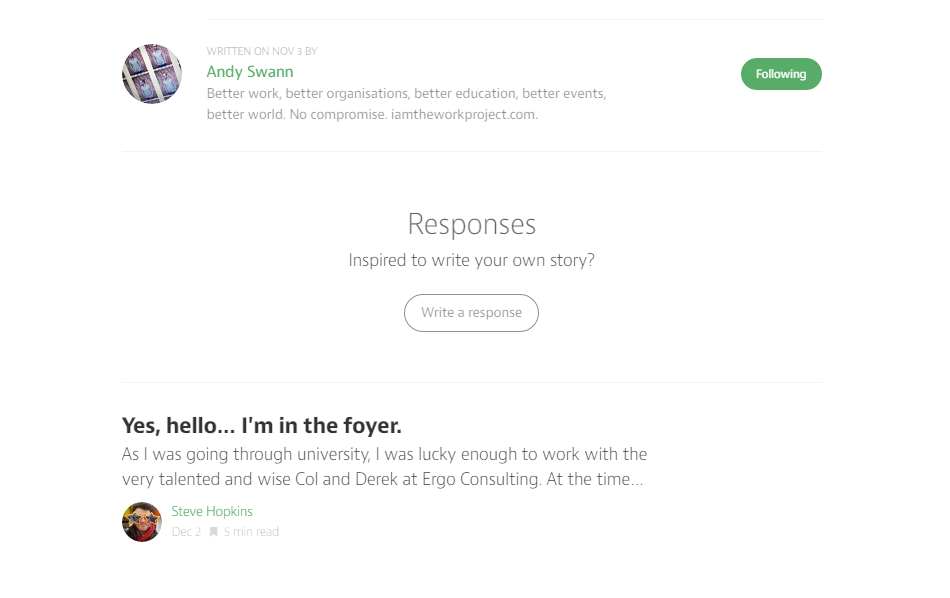
So, what will happens to the conversations that take place around blogs? Could we see a return to conversations on blogs in a different and even more traditional sense? Here’s what I think is shaping up. For many reasons, we’re seeing more and more places pop up where the product and/or platform you’re using not only offers you features that help you write the blog, but also help you distribute it. Medium and Tumblr are the archetype here. Medium has a beautiful feature that seems newer than most that allows you to respond to a post with your own post. I did this a couple of weeks ago when I wrote this response to Andy Swann and found it a great experience.

Medium Response

I’m really enjoying using WordPress.com at the moment because I can feel that it’s maintaining the a place for me to build up a life’s work, similar to how Fred Wilson describes it here. But I can also feel that it is getting better and better to use for following and responding to others with long-form writing. So much so, I think it will stay ahead of places like Medium in the long run.

So. No more comments but not necessarily no more conversation. If you’d like to chat about anything I’ve ever written here, I’d love to keep the conversation going either in your own blog post (by simply linking back to a post), reblogging my posts on WordPress.com or mentioning me on Twitter. I look forward to chatting with you sometime soon!