Wolf man and Biomimicry

I caught a fantastic documentary on Discovery today, which related to the book I’m reading at the moment, Biomimicry.

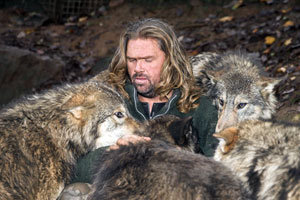
The doco was about a guy named Shaun Ellis, who left his family and life in society to raise a pack of wolves in captivity. It’s a long story, one that is better capturedhere by ABC news.

Shaun Ellis - Wolfman
The interesting part to me, was the amount that Ellis had learnt from the wolves, and how he was applying this to life in civilisation. One such example – for years we have been shooting wolves for encroaching on the land of farmers. This has always been understandable – given they often kill young livestock, which costs the farmer financially. In Poland, where a law was recently passed preventing the shooting of wolves, farmers have become financially ruined by the constant presence of the animals. Ellis, convinced there was a better way to prevent the wolves journeying to the farms than just shooting them, put his knowledge to work and came up with an innovative solution.

He went to a farmer who had approached him for help, inspected the property and investigated the wolf pack which dominated the territory. Once done, we created a CD of wolves howling in a ‘defensive/territorial’ way. He got the farmer to play this – once daily at dusk over his farm using a normal CD player and an amplifier. End story – the wolves have not attacked in months.

It raises a great many questions. But the theory behind listening to the problem and then solving it as nature would is immensely powerful. The very reason the wolves have a defensive/territorial call in the first place is to ware off other packs. Makes perfect sense. The scientists (boffins) applaud the idea in theory, but require more specific research to be convinced. Sigh.

The Pmarca Guide to career planning…get on it!

Okay – if you have been reading this blog you’ll know that I am trying to live the Brand Me life. I started this blog mainly to try to capture my portfolio of projects going on, how I was juggling the opportunities presenting themselves in each one, and to start conversations with other who were also trying to live this way.

Get ready for the next installment. If you have not already, get on to Marc Andreessen’s blog and read his guide to career planning. It’s gold…a great conversation is now set to open up about Project Life and career development not focused on HR Functions, Line Promotions and boring 9-5ers.

A few pearls from the article…

Pearl #1: Career Planning = Career Limiting.

I can’t agree with this more. I once met a guy called Bill Horman. Bill had progressed through life leading many different cool govenment projects (oxymoron?). He started as a cop, simply did a great job, always took on more than he could handle, and as a result has never been for a job interview. Every 3-4 years, he would get a call from someone he had worked with, offering him another position. Bill is now the General Manager of Crown Casino’s Community Affairs, loving trying to make great things happen with, quite honestly, a s**t load of money.

He lived (lives) his career in the moment, and is ‘on fire’ in the Melbourne Community. I have, since meeting Bill, tried to live a my life a similar way. This blog title, The Squiggly Line, denotes a life and career that are one and the same. One that doesn’t travel in a linear fashion but…well, squiggly.

But, as I posted previously, sometimes Part Time People = Part Time Results, which leads to the next pearl…

Pearl #2 – Living the portfolio life

Marc points out the importance of not planning every step of your career, but instead having an attitude more befitting of a stockbroker. I love this point – and try to pay attention to it often. I think a career is more like a portfolio, and myself being a younger person, my portfolio currently includes a start-up and undefined junior position at WVA, doing some really cool innovative thinking and projects around how the largest non-profit company in Australia can do stuff better.
Pearl #3 – Get some ‘great skills’

Finally, Marc also points to skill development vs career development. I, again, agree with this completely…but would like to take it a touch further. I think skill development is crucial. I would like to consider that I am developing a skill set primed for innovation and making things happen. This is where I take things further. Skills are good, but, observing Napoleon Dynamite, sometimes your ‘great nunchuk skills’ do not get you as much payoff as you would like. I think it’s important to have a larger, unquantifiable but guiding goal to help drive your skill progression. Case in point, mine is to Make Stuff Happen. It has a real meaning for me, and when faced with different opportunities I ask myself the one simple question – does it help me build skills to Make Stuff Happen?

gallery_napoleon_dynamite_1.jpg

Napoleon…had “great nunchuck skills”, but didn’t get him far with the ladies

If not, then I leave it. If I can see the skills I would improve by being part of that project as a key ingredient to ‘making stuff happen’ then I take the opportunity, add it my portfolio, and start the learning.

Any other thoughts? Please, do comment or share! How do you manage your portfolio?

NPV and the Non-profit world

If you we’re following me on Twitter earlier today, you would have been barraged with thoughts and ramblings about using Net Present Values to gauge how successful a program may be in non-profit world. (Now THATS blogging gold, I hear you say!).

nugget.jpg

Regardless, I thought I would give it a shot. Of course, Net Present Values are essentially the value of the cash flows that stem from money invested today. Simply, the NPV helps understand whether spending x amount on one venture is worth the expense now, for the future gain.

Of course, that’s pretty hard to quantify in NGO Land. Most programs we run here at WV are not set up to profit, and so the amount of cash flow generated from the activities is not the most appropriate measurement. So…what did I come up with?

Eyeballs (groundbreaking…huh). By valuing how much it costs for us to get our message across using different programs, we can give a rough estimate of how much cash we would need to bring in to break-even. By using that figure, we can then get a better feel for whether the funds we spend on one program will provide a ‘return’ on that investment (i.e – more people knowing/caring about poverty…in this case).

Anyways, I’m experimenting with it at the moment…any other thoughts about how to measure the effectiveness of proposed investment in different programs which collect no cash and by definition cannot be profitable?

Pixar – 20 years of animation

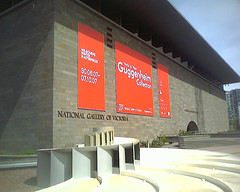
Today, I finally got the chance to visit the Guggenhiem and Pixar, 20 Years of Animation, exhibits at NGV and Fed Square. The Guggenhiem was fantastic, and well worth a visit if you get the chance before it ships of-shore again on the 7th of October…but the real gold was to be found at the Pixar show.

stub.jpg

pixar-front.jpg guggenhiem.jpg

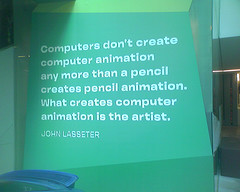
Upon entering, you are confronted with the following quote from John Lasseter, Chief Creative Officer of Pixar…

lasseter.jpg

Seeing that, I knew I was in for a good one. The exhibit is rigged to showcase the process Pixar goes through to create a film, and what they focus on to build such powerful stories. It was great, and is well worth the (measly) $15 to get in if you, like me, jive off anything relating to innovation and creativity. The exhibit takes down the curtain around Pixar in a wizard-of-oz kinda way! Some highlights of the exhibit are below…

1) Special document here! I kept the map of the exhibit they give you when you walk in…check it out here

2) Definately spend time (lots) on the Interactive Kiosks. Listen to how they create the story, through their rigorous creative process around storyboards. This is great, and after listening I can see why each scene in each film works out so great. They map ,improvise, create, act each scene out in a pitch to a grou pof Pixar employees. Then, John Lasseter (seems, the heart and soul of the company, given he exhibit) adds his bit, sending the ‘Storyboard Editor’ back to his drawing board before the final flow of the scene is nutted out. Why don’t every company have a ‘Story Board Editor?’ Everyone is selling an experience now, so why not map it out as the pro’s do??? Must re-read The Experience Economy…

3) It was evident from the numerous quotes and storys told within the exhibit that the focus within Pixar is very much on creating emotionally powerful stories. The fact that they create these with high-tech computer graphics is neither here nor there…as is quickly evident from the freehand artwork on display.

4) There we’re, thankfully, many film clips and and film extracts (as you would expect going to a FILM exhibit). There was a show on how Pixar create their worlds (The Artscape), as well as a large collection of award winning Lasseter short films on display when you first enter (including the famous table light clip that inspired the Pixar logo). Obviously, make sure you see all of these things. (Although, the Zoetrope was a bit trippy…)

Overall, I loved the Storyboard process most, and am going to try this out in more of a business application way very soon…listening to the Pixar guys pitch each scene so passionatley inspired me!!!

Well worth it!!! *****

What I'm reading at the moment: Mavericks at Work

I thought I would post what I am reading at the moment, seeing as I suggested last post that I havn’t read the Craig Hassed book yet.

I’m currently reading Mavericks at Work: Why the most original minds in business win. The title is okay, if not a little wanky. But, the content is quite good. It is written by William Taylor and Polly LaBarre. Taylor, of course, is a cofounder of Fast Company and the founding editor, whilst LaBarre was a journalist for the funky business mag. As you can imagine – the content is very similar to the magazine, which is fantastic. Imagine some of the magazines best articles and themes, extrapolated and then discussed in more detail. It’s an excellent read so far.
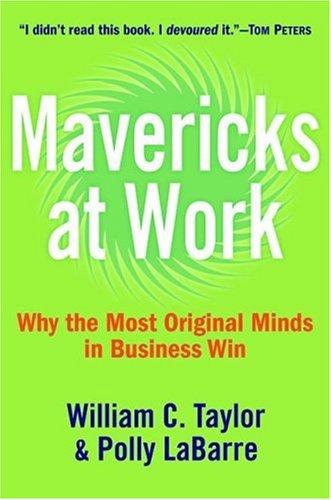
mavs.jpg

One turn of phrase I would like to share, is the Rule of Crappy people. World Vision is looking for people right now, and as always, are looking for the best, so my head has been in the space of thinking ‘who might fit that role?’ Apparently, Starbucks came up with an idea where their staff carry with them a card with a free coffee on it and a private number, patched straight through to a Starbucks Talent Seeker, that they can give out to someone random they think has the Starbucks quality. Be it a great checkout chick or storeperson. Starbucks Big Cheifs rightly claim that they have 10.000 employees that are everywhere, and often better at recognising what it takes to be a Starbucks employee than most. The card allows people to call, get noticed, and then get tracked by Starbucks – there may not be a position yet, but the company ackmowledges that keeping in touch allows them to offer positions to talent first, instead of advertising. Cirque De Soliel has a beefed-up (scientific term) tracking system, which logs a database of 30,000 potential circus people. Each one is kept in touch with personally, and constantly invited to audition for different, specifically tailored roles.

Winner!!!armstrong-9.jpg
A dream of mine, would be to see organisations such as World Vision act the same way. At the moment, there is a clear want to ‘follow a transparent’ process – which I completly understand and appluad. But, I think the process falls down because it only kicks into action when there is a need to fill a gap. People line up and volunteer at WV for years, just trying to get in to work for a company they have a real passion for. And, there are a number of incredibly talented people plying their trade here that will have very switched on friends and networks. Yet, there is no ‘Starbucks Card.’

Here is what I would do, putting on my ‘Head of People’ hat.

1) Create a role within the HR team dedicated to building a talent list, compiled from people either employed now/days gone of World Vision.

2) Create a Starbucks card type system, encouraging people to pass on to people who are ‘World Vision like.’ These people get direct access to te position created above.

3) Start a HR Blog, displaying all the positions WVA is currently trying to fill. This blog, moderated by the person created in #1, will answer questions about the roles, as well as questions about the org, and how people should best apply. This allows them to ENGAGE with people, rather than hope people carry out the incredibly arcane and transaction action of ‘sending in a resume.’ (Resume’s, and job-recruitment in general, have not changed since the days of the typewriter. Yes, we now have seek.com (hear me shudder), but that has only changed the method by which people submit their resumes. The game has not substantially changed in 50 years. sigh.

4) Ask new employees to provide details of their favourite co-workers from their past employees. This is a touch personal, but if you recruit talent, chances are they had a few kindred spirits wherever they came from. Get the logged, sign them up to the RSS for the job-blog, and then start havign conversations with them.

5) People share – this one, I’m claiming as my own. Non-profits, especially, lose good people to corporates because they can’t match the 1) diversity of work people get in larger, commercial companies and 2) the salaries. Yet, the skill set of the NGO class are highly relevant to todays commercial and corporate world (building grass-root networks, building campaigns, being entrepreneurial with small budgets and big objectives, creating communities and advocacy for a cause.) We shoudl staff share. Why, oh why, can’t Big Corp X share a FTE position with Big NGO Y? Telstra and WVA, share a marketing star??? The shared learning would be enormous, and the person in the position would develop a kick-arse skill set.

Just some thoughts – what are yours? How would you keep talent around? Anythign wrong with #1 thru 5?