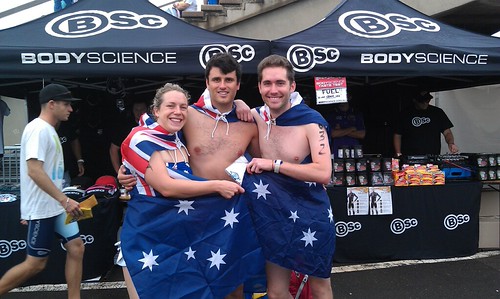
Happy Australia Day!

Today is Australia Day. Rose, Kyle, Marty and I started off the day with a swim in Sydney Harbour, called the Great Australian Swim. It was a 750 meter swim, out and back, starting from the Opera House. Of course, we swum it in our Australian swim wear and even managed to make the full distance with the flag on our backs. It scared the hell out of me…I’m still fairly new to this open water swimming caper!

Australia Day

Happy Australia Day!!!

The Young Centenary Foundation is a good idea

There’s a group of young people who have just recently formed a group whose mission is something I think deserves a lot more support than it currently gets. The organisation is The Young Centenary Foundation. Science, as we all know, is a fairly important part of our society. Science informs many of the behaviors and actions we take as a people. It helps us discover what it means to be human. It helps us to stay healthy. It helps us to stay sane.

Unfortunately, whilst the endeavors of the scientific fraternity are technologically progressive and experimental, the structures around that research and progression is not. Science is still, largely, carried out today the same ways it was carried out decades ago. A core part of this is the presence of university students who decide to do a PhD on a very specific topic of research, in the hope of discovering something and being published.

Our initial ideas of people who are doing a PhD is one of grandeur and prestige. This is true, in many respects, but also untrue in many others. One key problem facing many PhD students is that of funding. They are ‘paid’ a measly stipend of somewhere in the range of $20-30k a year to toil for much more than full time in a lab running their experiments. This doesn’t sound too bad, until you consider that fairly standard scientific PhD can take up to 4 years.

For most talented scientists, the opportunity cost suffered from turning down plum corporate jobs for 4 years of hard work on less than minimum wage is too hard to refuse. Only the truly dedicated take it on. And then, as if that wasn’t already hard enough, a student can work for 4 years and get close to achieving a break through before their funding is cut and they’re forced to move on from their work. I dare not think of all the great work that is left 90% completed in labs all over the country (indeed, the world) because a student couldn’t secure funding to fully complete their study.

That’s where the Young Centenary Foundation comes in. It’s been formed by a core group of young scientists, philanthropists and media professionals under the age of 35. They plan to raise money to contribute towards PhD students working at the Centenary Institue, so they can finish the work they started. They’re not planning on making them rich…just making the process of completing a PhD a little easier. From their Facebook page.

Most young scientists are unfortunately unable to continue the work they start at Centenary Institute during a PhD because government and university supported post-doctorate funding is hard to come by. For this reason, one of our mid-term goals is to fund a post-doctoral research position (approx. $80,000 per year) for a young scientist working with a disease that affects young people.

$80,000 a year is a lot of money, but a drop in the ocean that is scientific funding. I look forward to supporting the Young Centenary Foundation in the ways that I can this year and encourage you to take a look, too. Congratulations to the crew behind founding it, and to the Centenary Institue itself for driving such a positive change in the way science is conducted here in Australia.

What are the experts concerned about?

Reading the Quarterly Essay the other day has stirred in me many of the thoughts I came to when reading Stuart Brand’s Whole Earth Discipline a few months ago.

One of the things that Brand mentions a lot in that book is the amount of fear that is generated by people that don’t actually know what they’re talking about. He specifically talks about how the environmental movement has scared people beyond the point where they can talk rationally about important issues, such as Nuclear Power and Genetically Modified Food. See the image below, which is a screenshot from my Kindle highlights.

Whole Earth Discipline

However, when you ask the experts about these options they’re not the ones that are scared. Nuclear experts the world over have spent lifetimes understanding nuclear power and have a good weighting of the risks involved. They’re not the ones that are concerned about nuclear power. Biologists are the same with regards to GMO foods. The people that know that most, are often the least concerned. Yet we continue to disregard their advice, because more of us share the same fears. We are sheep.

What's in your pond?

A few days ago, I posted about how the presence of frogs in a wetland helps to show the health of that ecosystem. When I took that photo, I was on a walk on the property that hosted Railscamp. I took another photo that day, which I also thought I would share here.

Pond

On this one, it outlined how a human made sedimentation pond was designed to slow the pace of the water flowing through the wetland and allow waste to drift out of the flow of the river system. It’s a natural way to capture the stuff that otherwise would add to the poor health of the ecosystem.

Again, I couldn’t help but think about my own life and how this might offer some insight into the world we live in. I thought about but the flow of information. Especially, how information is currently moving towards a more stream based medium. Twitter, Facebook, Yammer and many other services have worked tirelessly to provide users a stream of content that they opt in for.

In the same way as the pond, we need to remain cognizant that not everything in your stream is always going to add to the health of your own ecosystem. What matters most is your attention, and how you direct that. Having a social stream in your life helps with directing and spreading your attention greatly. But every so often, it’s still important to stop every now and then and assess what’s in your pond and how you can make that better. Doing so will add to the health of the overall system you’re a part of, and encourage better flow of information and knowledge.

Choosing between progress and the planet

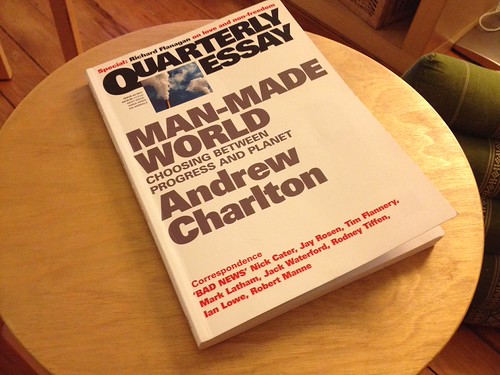
Dad posted me the latest Quarterly Essay this week and I had some time to sit down and read through it this afternoon. I don’t normally get a chance to read these, although enjoy it when I do. I like the dedicated nature of it, where one author gets to write a long essay on one particular topic. It’s a great concept. I should probably subscribe.

QE44

Anyway, I digress. This quarters essay is by Andrew Charlton, who was the Senior Economic Advisor to the Prime Minister from 2008 to 2010. His time in that role saw him take in the infamous Copenhagen Summit held in 2009. That sets the scene for the essay, as he discusses why the approach of many developed nations to that summit was wrong and how that lead to the relative disappointment that stemmed from the inaction seen from it.

The main contention of essay is that we’ve traditionally argued that we can either choose economic progress or preservation of the planet; but not both. Charlton walks through why this argument is basically flawed and also displays how many organisations; from right to left, continue to base their strategies and focus on winning this argument. Essentially, we will all lose if we continue thinking in this way.

One thing I’ve taken from the essay was the following graph. I had never really engaged with what the 5% carbon emission reduction target that Australia has, except to think that 5% is not much. However, reading through Charlton’s thoughts, it becomes pretty obvious that it’s a huge task, which actually represents a target of reducing our carbon emissions by about 31% in real terms. Our population and energy use will continue to rise in the next 10 years, and so to see a 5% net reduction come into effect, we’ll need to reduce our total reductions by about 31%. Interesting stuff.

Graph

If you’re interested in the whole environmental movement and what’s happening, I’d recommend reading the essay. It’s very well balanced and takes a pragmatic approach, which I really like. Stuart Brands Whole Earth Discipline is similar in it’s message. If you can’t get your hands on the essay itself, theres a video with Charlton on SlowTV where he discusses the essay.