My thoughts on working from home

Having started working for Yammer and being based in Sydney, I’ve been working from home for the first time in my career the last 3 months. Michael Fox just wrote a thought provoking post over on his blog, 22 Michaels, and I thought I’d share what I’ve found about working from home.

1) You need to be disciplined

One thing that became immediately apparent was that I needed to really invest in my time and my discipline. When you work in an office, it’s very easy to get caught up in the rhythm of your life. You get up at the same time, shower, breakfast, commute, office, coffee, chat, email…etc etc.

At my previous job, I’d happily keep my email open all day because it also served as a portal into what was going on in the office. When you’re working at home, having your email open (or any service that really drains your attention) can be dangerous. The first week I got back from San Francisco, I spent most of my days buried in my email…even though I didn’t have a huge amount of email. I’d also spend a lot of time in Yammer, obviously, and days could fly by without feeling like I was achieving much strategically.

I needed to be more disciplined about what I was doing with _my_ time, and the better I’ve got at this the more productive and happy I’ve felt.

2) Batch your email

I now try to batch my email, and only open it twice a day. I normally check it first thing in the morning, and then again towards the end of the day. There are lots of people who have written about this. It’s also well worth reading Getting Things Done, by David Allen.

3) Be strategic

The robots are coming. Tim Hwang now reckons he can build a robot that will do what Lawyers do today. If you’re not careful, you’ll be replaced by a robot soon enough and so it’s crucial that the work you do every day is highly (highly) valuable. I learned this very early on, as it felt like I was being to reactive to the tasks that were coming in.

If you work from home, you need to make time to be strategic and brainstorm/discover/plot the next actions and parts of the your work. What can you do to really provide value to that client? What do they really want? Do you really understand their business enough? Those are the kinds of questions that robots will never fully be able to answer, and their also the most valuable questions to be providing insights on. Don’t get caught up just ‘doing things.’ Give yourself time to make value.

3) Coworking is fun

I’m a people person – it’s one of the things that makes me, me. Working from home can be a real challenge because I have days sometimes when I don’t see people. Find people you can work with, and make sure you organise this. Michael was kind enough to have me in the Shoes Of Prey office a while ago and it’s something i’m looking to repeat soon. I also try to work onsite with clients as often as I can, when it makes sense.

If you cowork in Sydney, let me know where and I’ll come meet you sometime. 🙂

4) Be aware that you change the space

I live in a little cubby house, studio apartment with my amazing girlfriend Rose. What’s hard about working, is that Rose gets home at about 5pm most days. By the time she get’s home, our little cubby house has become a man cave and I’m often still happily working away on something that I’ve got some rhythm on. That’s not really fair on Rose and so I’ve started to aim to finish up my day at as close to 5 as I can. I pack away my laptop and then help clean up the space. It’s quite a simple thing, but hard to do sometimes.

At home, you really notice the difference between times when you’re working and when you’re not. Because, if you’re not working then you’re just at home! To me, the ideal mix is looking like having a desk somewhere that I can go to cowork with people when I feel like that, but then work from home at the other times.
Learning to understand hidden data

I was watching some videos today and stumbled across a few by a guy named Ben Goldacre. Goldacre is a doctor, who has become an epidemiologist: which is the science of how we know in the real world if something is good for you or bad for you. That may sound fairly abstract, but it’s actually something we all experience many times a day.

Have you ever convinced yourself that having another block of dark chocolate is ok, because it’s good for you? Or perhaps another glass of red wine? Or taking fish oil? These are all acts that have probably stemmed from an epidemiologist at some point; who has completed a survey, crunched the data, and decided that the red wine you’re now about to drink is going to reduce your chances of getting cancer.

The contention of Goldacre’s talks are this; that the surveys and data that we hear repeated to us through various media channels are often flawed scientifically and that we should be aware of this. Further, we should keep in mind that most things we believe are merely points of view that we’ve held for one reason or another and should be remembered as so. A point of view is, after all, just a view from a point. (Thanks Col!) Further to this, things react differently when they’re being observed. But that’s a topic for another day.

But so what? What does this mean for us, really? What is the macro trend here?

We’re going to see more and more data pouring into our lives – even if we don’t know about it. Data sits below the consciousness of most citizens. Do you ever question whether the pill given to you by your doctor successfully passed it’s double blind placebo test as well as beating out the competition drugs that were already on the market? I certainly don’t.

And so, it’s important to realise that as things get more complex in terms of the data we become exposed to through our more quantified lives, things are largely still uncontrollable. I love how in the video Goldachre comes back to the traditional view; If you want to live longer then you should eat more fruit and veg, be fit, not drink or smoke and keep your weight down. But you might still die early.

It’s becoming more and more important to understand the differences between mysteries and puzzels.

Monitoring my energy use with @Segmeter

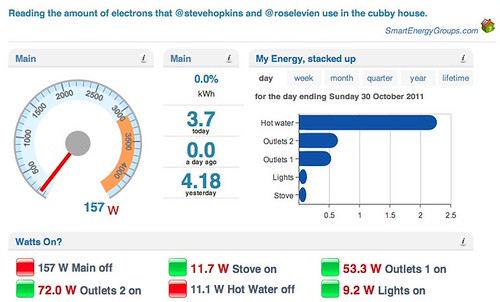
Yesterday evening, with the help of Sam Sabey, I was able to have my SEGmeter set up to monitor my electricity usage for my home. This is a very exciting development for me, as it’s something I’ve been trying to hook up for a while. This now means that I (and you!) can see how much electricity Rose and I are using in our studio apartment, the Cubby House. To see how much energy we’re using, in real time, check out this page. You can see an image of our dashboard below.

SEGMeter screen shot

So what is it? Here’s a few thoughts.

1) People have talked about having smart meters in their homes for quite a while. By itself, it’s not a new idea. All the energy companies have probably, at one time or another, made the attempt to implement smart meters in the home. In fact, Energy Australia is rolling out smart meters to businesses over the next decade. .

2) However, these aren’t open source or, perhaps more accurately, user based activities. With Smart Energy Groups, Sam has created an open source and diligent community of people who care about monitoring their energy use. The organisational fulled smart meters, such as those talked about above, are much more expensive to make and install. My SEGmeter didn’t cost me much, and is something I have full control over. I can tweak it, connect to it via API, and generally modify my use of the segmeter to provide me with the information I need to make better decisions about my energy use.

3) Dan Hill wrote a fantastic blog post years ago in 2008 titled, ‘The personal we.’ In that post, I remember getting really excited by Dan’s insights and thoughts on what could become a community based, energy saving game. Specifically, I remember seeing a sketch he had made of what the games score board could look like. You’ll notice it actually looks remarkably similar to what Sam’s SEGmeter dashboards have become.

Dashboard

He also drew up another fantastic sketch of houses in a neighborhood with a score hovering above them. I’m excited because having the SEGmeter installed in our home now means we can participate in this game which seemed so far away in 2008 when I read that post. That’s amazing.

Street

Energy is one of those things which is not going to go away for the human race. Energy makes an impact on each of us, in every minute, of every day. It’s something that’s unique in our world, as it’s a concept that everyone understands. People living in the darkest corners of Sudan, DRC or Zimbabwe understand as intuitively as those of us living in Sydney, London or New York the importance of having energy available to do what needs to be done. We’re at the very beginning of understanding the true impact that energy has on us as a global population, and having things like the SEGmeter exist means we can begin to get a feel for what that is through data. What an exciting time to be alive!

If you’re interested in hooking up a SEGmeter to your home, get in touch with Sam here: http://smartenergygroups.com/contact

The art of learning

I’ve just begun reading a new book; The Art of Learning, by Josh Waitzkin. I’m only a few chapters in, but already I’m seeing the benefits of the insights the book has to offer. I watched the terrific film, Searching For Bobby Fischer a couple of nights ago, which dramatises Josh’s early life as a chess prodigy. It’s well worth a watch on it’s own but the book is providing great insights into the process of learning in itself. Indeed, it’s a book which discusses how you can learn, to learn.

When I was at High School, I was lucky enough to have some fantastic teachers. One of them was Mr McGuire, who was my year 7-9 maths and science teacher and later my VCE physics teacher. He used to have many little sayings and beliefs that he would impart on us in class, but probably his greatest lessons were around the process of learning. He would often say “Don’t regurgitate” – if he suspected one of us simply reading or reciting the answer that seemed most right from the text book, he would look at you with playful glee and ask a simple question like “why is that so?” or “but how do you know?” – which would instantly bring the facade of our attempted learning down. Afterwards, he would pick us back up again, laboring that this learning we were doing wasn’t to impress him or pass a test, but to be better learners at life.

I approached him in the playground one time in my final year of school, when I was struggling with a fairly complex concept in physics and simply stated that “I would never get it.” He laughed, and then said “well, then, you’re 100% right.” He continued to ask me how long I’d been learning the concept for, before I told him we’d started learning it at the beginning of the week. He simply stated that it’s ridiculous to think a concept could be learned in a week, and suggested that all things take a matter of time to learn, if you’re determined enough to learn it.

As I’ve recently begun working at Yammer, there’s no shortage of things for me to learn and lessons I need to ensure I understand. I’ve found great strength in reflecting on the lessons of Mr McGuire in the past 6 weeks or so and reminding myself that no lesson learns itself. I’m enjoying the process of mastering a new job and learning something new every day.

The book picks up on this sort of thinking, and (early on) highlights the differences between entity and incremental theories of intelligence. From the book:

“Developmental psychologists have done extensive research on the effects of a student’s approach on his or her ability to learn and ultimately master material. Dr. Carol Dweck, a leading researcher in the field of developmental psychology, makes the distinction between entity and incremental theories of intelligence. Children who are “entity theorists” — that is, kids who have been influenced by their parents and teachers to think in this manner — are prone to use language like “I am smart at this” and to attribute their success or failure to an ingrained and unalterable level of ability. They see their overall intelligence or skill level at a certain discipline to be a fixed entity, a thing that cannot evolve. Incremental theorists, who have picked up a different modality of learning — let’s call them learning theorists — are more prone to describe their results with sentences like “I got it because I worked very hard at it” or “I should have tried harder.”

Waitzkin, Josh (2007-05-08). The Art of Learning (p. 30). Free Press. Kindle Edition.”

The books a fantastic read so far and I’m looking forward to considering my own strategies of learning as I continue reading it. It reminds of Amir’s thoughts on annotating the game, which I posted about a few years ago.

I'm in San Francisco

Just a quick post today…call it a traditional blog-status-update thing. Yeah.

@rosshill and I on @jwswj's amazing rooftop.

I’m in San Francisco as I write this, starting my induction with Yammer. It’s been an amazing few days so far and promises to be am amazing week! Let me know if you’re in town…