How to write documentation for product management

I’ve been engaging with the question “how do I document the different products that I’m working on” at the moment – mainly from a governance and communication perspective. Product management is not a discipline that is necessarily well recognised here in Australia, although everybody does it. Think about the last time your company, or yourself, decided to start a new product line or tweak an existing product to match a customer’s new or changing requirements…that’s product management.

So I’ve been asking questions of myself like:

  • How do you create a strong product management process, that suits the way our culture works?
  • How do you document the various developments as you go, to make these changes transparent?
  • What kind of sign-offs and decision points are used in agile product organisations? And what documentation is required around this for good governance?
  • How do you ensure that what you develop will actually be used by customers? And how do you (again) ensure this is the focus of our work (rather than the focus being the ‘building’ of that product).
  • How can we do this in a lean, and agile, way? I still believe in the agile manifesto of working software over heavy documentation…but I’m also aware that we’ve had some problems were software has ceased to work and the documentation was too light on to allow our teams to re-configure it easily.

I wanted to share a few of the links and resources I’ve found, that I’ve been leaning on fairly heavily as I think about this. You can also check these out on my Trunk.ly profile, under the (growing tag) productdocumentation.

On that, I’d really recommend reading/following the work of Marty Cagan from SVPG (Silicon Valley Product Group). All of his stuff I’ve read so far has really helped inform my thinking. Thanks Marty.

What are your favourite links/articles on documenting product management? Please share in the comments section below!

Re: Google 2015: What will it look like?

This in response to the post that Robert Scoble put up on his own blog a short time ago. I really resonate with the post – thinking about how Google may move is a favourite past-time of mine, as well as a handy thing for work. But I disagree with the main contention of Robert’s post, that they will end up being another disappointing Microsoft. Here are my thoughts, to add to the pile.

Google Dalmation

1) Voice Recognition

Google is one of, if not the best, company leading the global efforts to turn speech into text. It seems like a simple enough task, right? But it’s still very much driven by humans. Google have made great acquisitions (as well as hired a heap of great people) over the past 4-5 years to make this a reality.

Given there are 35 hours (at last count) of content uploaded to YouTube each minute, and all of those videos are machine translated by YouTubes still nascent captioning algorithm, points that they’ll crack this soon enough.

Also note their purchase of GrandCentral years ago (which has become Google Voice – also piping in speech-to-text learning’s for their algorithm) and you have a very powerful sandpit to play in. What’s more social than allowing everyone on the planet, disabled or not, to have access to speech that is translated into text?

2) Translation

Once you have speech-to-text nailed, then it becomes a simple step to say “well, couldn’t I translate my English, in real time, to another language?” Yes, I reckon you can.

If you haven’t checked out Google Translate for a while, you need to revisit it. They have a record number of language pairs figured now (french-to-english, french-to-spanish, etc etc).

Not only that, the common languages (Spanish, English, French, Mandarin) have a scarily human voice that will read your translation back to you. The Spanish one actually has inflection! A robot, speaking with inflections in their voice!

It’s 2011.

Eric Schmidt, when he was CEO, used to talk about how this could lead to better understanding of people around the world, leading to more chances of peaceful resolutions. I’m not saying Google will create ‘World Peace,’ but the ability of all of us to communicate the globe over easily is huge.

3) Mobile

Google, through Android, have been working on mobile for a while. But it’s still very early days for them. Once the marketplace and native apps catch up with the beauty of the iPhone, the utility of this will be immense. Google’s product mix of Google Latitude, Maps, Google Earth provides it with a beautiful sandpit, again, to play with new ideas to connect humanity. Pair this with the translation and speech to text stuff above, and you really start to see some pretty incredible stuff.

4) Google.Org

In the 2004 Founders’ IPO Letter, Larry Page and Sergey Brin, when discussing what has now become Google.org are quoted as saying;

“We hope someday this institution may eclipse Google itself in terms of overall world impact by ambitiously applying innovation and significant resources to the largest of the world’s problems.”

I think this could be a reality in 4 years/5 years. Consider Google is only a 10 year company, and they’ve just begun hiring specific people in different areas around the world to soley work on Google.Org projects. This is more of a darkhorse and perhaps a ‘gamble’ to claim it will be bigger than Google.com – but I feel that these sorts of projects could add significant dollars to Google’s bottom line. Don’t think about it in terms of what Google currently do now, but what they will have at their disposal with the benefit of time. Language translation, planetary data, satellites over Africa and many other things we probably don’t know.

I’m not saying that Google will continue to be the darling that is has been for the past decade. Certainly the gloss is off and it’s perhaps not the employment destination that it once was. But I think we need to be careful not to throw the baby out with the bath water. Google will remain one of the most important utilities on our planet for at least the next decade, and I reckon, even beyond that. Whether they ‘get social’ is neither here nor there for me.

Compassion and performance

Pete Spence wrote a fantastic blog post on Performing in a self-organizing world recently and it sparked some thoughts of my own.

I’ve recently been reading ‘The Art of Happiness’ by His Holiness the Dalai Lama and one of the lines of inquiry I’ve most enjoyed in the book is that compassion ultimately leads to happiness. Taking this line of thought one step further, we can see that to achieve high performance, be it in your sport, your work or your personal life, requires compassion. I believe that these two topics intersect – that by practicing a high level of mindfulness and compassion in the situations you are placed, you can adequately deal with the complexity of self organizing systems – thus performing.

Street art

From the book:

“Compassion can be roughly defined in terms of a state of mind that is nonviolent, non-harming, and non-aggresive. It is a mental attitude based on the wish for others to be free of their suffering and is associated with a sense of commitment, responsibility, and respect towards the other.”

And on garnering a compassionate attitude, even when faced with resentment.

“Now, in general compassion, when you are taking on anothers suffering, you may also initially experience a certain degree of dis-comfortableness or un-bearableness. But in the case of compassion, the feeling is much different, underlying the uncomfortable feeling is a very high level of alertness and determination because you are voluntarily and deliberately accepting anothers suffering for a higher purpose. There is a feeling of connectedness and commitment, a willingness to reach out to others, a feeling of freshness rather than dullness.

This is similar to the case of an athlete. While undergoing rigorous training, an athlete may suffer a lot – working out, sweating, straining. I think it can be quite a painful and exhausting experience. But the athlete would take it as a great accomplishment, an experience associated with a sense of joy. But if the same person was subject to some other physical work that was not part of his athletic training, the the athlete would think ‘Oh, why have I been subjected to this terrible ordeal?’ So the mental attitude makes a tremendous difference”

It seems to me that maintaining and cultivating an attitude of compassion is therefor required to act in a self organizing system. How else can we work completely without an actor or instigator, if we do not trust one another?

What do you think?

A productive day

Today has been a very productive day! After attending Mindful on the weekend, and then catching up with a few people after the event, I’ve come back up here to Sydney with a rather expanded balloon. Jan Stewart wrote the other day about how peak experiences can expand your level of consciousness, before you shrink back close to your previous level. What’s lovely is that after such experiences as Mindful, you never quite shrink all the way back. Just like how a balloon never quite returns to normal once you blow it up and let the air out.

I feel like I’ve grown that little bit more, and that I understand my ‘mind, mindless, mindful’ selves a lot more than before the event. The key is, continuing to keep the balloon expanded through mindful practice of the takeaways from the day. So what have I been doing today?

Journal

1. Dropbox, finally.

I register for Dropbox fully today. I’ve had an account for years, but never really learned how to use it. Ross Hill and I were chatting with Bryony Cole over breakfast on Monday morning and it came up that Fred Wilson had recently moved all of his stuff into the cloud. Ross had been using Dropbox for a while, and it just struck me a simple thing I could do. So I have. I’ll move all of my files slowly over in the next week. I’ve already made a great start. One of the important aspects that came out of Mindful was resilience, and my laptop and it’s encompassed files have always been one of those things I’ve ‘meant’ to back up/secure. It’s amazingly powerful to have done that today.

2. I bought a journal.

I was lucky enough to have an expansive coffee with Ron Laurie, one of the speakers from Mindful, on Monday afternoon at Kinfolk. I really resonated with Ron’s talk, and was grateful that he was able to spend some more time with me and walk me through a few of the finer points of his thinking. One of the great questions Ron asked me towards the end of our chat was “Do you journal, Steve?”

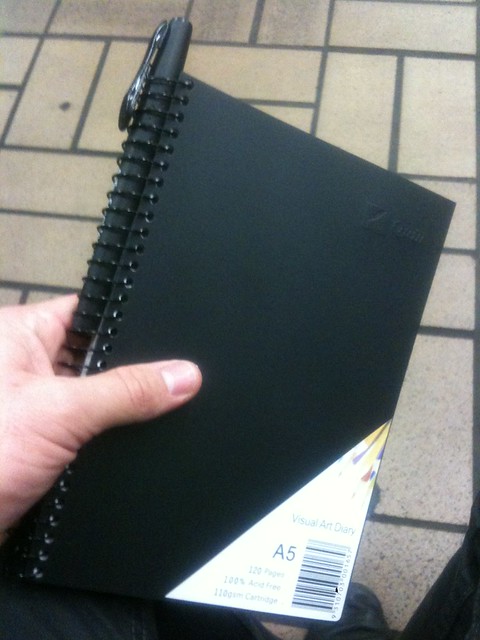
I’ve often bought ‘visual diaries’ and used them for notes, thoughts, tasks – the whole gamut. But I haven’t done that for a while now, and Ron’s idea nudged me into thinking it was probably a very good idea to start again. So, this morning on the way to work, I bought a journal for my ‘mindful’ thoughts. It feels an enormous relief just knowing I have an outlet there, waiting.

3. #deepdive

One of the parts of the day I really enjoyed was the meditation session Xavier Shay ran in the morning, and briefly in the afternoon when the Open Space session got a little too heavy for everyone. I enjoyed a #deepdive tonight, and look forward to picking up that practice again. I listen to a recording I have of Craig Hassed, to help me through the beginning stages of re-engaging with it. It’s worth watching and listening to Craig’s stuff on the Lantern Mental Health YouTube channel when you have the mind space. It’s a great place to begin your practice.

Taking open space to the edge

This is a post I wrote for @thisismindful, to describe some of what will be taking place on the day. Why don’t you join us? Tickets are still on sale at Eventbrite.

Open Space Technology is a fantastic tool for organizing groups of people together to solve complex problems. I’ve used and experimented with Open Space at events like Trampoline, CPX and the Lantern Mental Health Unconference over the last few years and have always been impressed by it’s ability to create interesting conversations. At Mindful on the weekend, we’re going to extend that experimentation once more, and push the concept further along.

Some of the things we’ll play with are:

1) A human grid

Open Space is great because it allows everyone the chance to set the topics, time, and place that sessions will occur. This is good except for when the crowd takes over and you get lesser quality sessions, which reduces the energy in the group.

So we’re going to have a person act as the grid. That’s me.

With a human grid, people will still pitch their talk to the group, but the human grid will only place the session into the agenda if it resonates with the collective assembled. Real interest can’t be faked, and our intuitions as a group are excellent at detecting low enthusiasm. So we’ll use that to select our sessions.

2) Rule of two feet

We’ve all been there before. You arrive for a session but within the first 5 minutes you realise its not for you. But you stay. The rule of two feet is one of the most crucial aspects of an open space meet, so why don’t people exercise it?

People get addicted to the people. They stay not because they’re contributing or participating in the talk, but because they’ve become attached to the idea of being a part of the group.

This is a shame, because the very best Trampoline sessions we’ve seen over the 5 events so far has been where all of the attendees of a session were participating, through active listening, discussion and enquiry – which can’t happen if some people in the audience would rather be somewhere else.

So, at Mindful, we’re going to remind you during sessions to move on once it stops resonating for you. Perhaps we’ll change the rule to the ‘law of resonating feet’ to really make that clear.

I’ll stop sessions and nudge you to move on to what resonates.

3. Space and Time

In an open space setting, all you can really control is the space you’re in, and the time you’re in it. As we’ve discussed above, creating sessions which resonate strongly with people is the aim, but resonance is more than just a good topic. It’s everything else, too. It’s the ambient nature of the space you’re in and a the suitable time to be in it.

So how do you create spaces which resonate? You make them appeal to different frequencies of thought. At Mindful we’ll create very different spaces, with different lines of enquiry to be drawn throughout the sessions. This way, it will hopefully become easier for people to discern what mood their resonating in at any given time and move to an appropriate conversation.
If you’re keen to talk or lead a line of enquiry, then come prepared to do so!

Join us at Mindful!