I’m writing this from my favorite cafe at the moment, The Falconer, in Sydney. I’ve had a terrific night tonight, attending Share Space and geeking out over all it had to offer. It’s the kind of night where the chill in the air is in perfect harmony with the stillness of the back-streets of Surry Hills. It’s the perfect night to write this post, which has been percolating in my head for a few weeks now.
I’m moving on from Ai-Media. About 3 weeks ago, I was told that the little company that we had managed to build from about 16 people when I got involved to about 75, needed to shrink it’s staff. There was a large cut-back announced, of which I was one. The product we’ve been working on, Ai-Live, is not yet generating the cash required to keep it sustainable and so as a result only staff directly involved in revenue related activities have been kept on. It’s a tough call, but the right one for the company to continue it’s journey towards ending disability.
But this isn’t a sad post! I’m so proud of everything that we’ve achieved at Ai’ in that time and personally am proud of my own contributions towards that. Unfortunately, these things just happen sometimes. I can’t wait to see what the remaining team deliver to all those people who require access in the future and can’t wait to take the valuable lessons I’ve learnt in my time onwards to the next adventure awaiting me.
In the time I’ve been at Ai-Media I’ve had the chance to experience and learn so many things and I’m a better person as a result. I’ve…
– Understood that the process of creating societal change is a long one, but still a worthwhile one to make.
– Better understood how communication amongst people in an organization works and how to amplify it.
– Played around with (and implemented) cloud/SaaS platforms internally with some stunning results.
– Helped grow a Yammer network to the point that it plays an important role in our organization.
– Learnt about how to work with a development team offshore, and how to be a product owner/product manager.
– Got my head around the principles of the Lean Startup methodology and begun understanding what it looks like to implement them in an organization.
– Learnt how to make an impact at an organization by being pleasant, playfully relentless and leading by example.
– Took the lessons of ecosystem management into an organization and actually did it.
– Started to learn how to code in Ruby on Rails and attend my first #railscamp.
– Helped build a continuous integration server and educate our team in the ideas behind Test Driven Development.
– Worked with many wonderful people who have all had a ‘special something’ that is worth sharing in and celebrating.
– Understood myself better as a person.
– Got the Sydney chapter of the Awesome Foundation started.
– Got started working on an awesome slow project with my man Bruno called Road.ly, which i’ll tell you about as soon as I get around to writing the post.
– Picked up very little AUSLAN, German and Spanish (Sorry Vic!).
– …learnt how to make amazing pizza on a Chimenea at #tbpsyd.
– …probably forgotten to mention many other things I’m sure I won’t realize for a while yet.
I’m excited by what the future promises and what it holds for me. I’m really looking forward to taking a slight pause, breathing in for a moment, before finding the next exciting journey and beginning it. Of course, i’ll let you know what that is once I do.
To all of those people I’ve share this time with, especially my darling Rose and the crew from ‘The Strathfield Office’, thank you from the bottom of my heart. You’ve made it the terrific experience it’s been and I can’t wait to share the rest of journey with you.
If you’re interested in catching a coffee and chatting opportunities, drop me an email. I hear The Falconer is pretty good…
I just finished reading Euan’s awesome blog post on patience. It’s a short one, but a great one. Thanks for sharing, Euan, and prompting me to post this.
I’ve been thinking lately that all of the work we do is as great as the time we give it to become awesome. We must learn patient stewardship when working with our organizations and friends.
I’ve recently felt the power of time in my work. I’ve noticed the people I work with, who you can follow on the @accessinclusion twitter list, are now amongst the people I consider my friends. I’ve noticed that, because of the respect and trust we share, it’s easier to have tough conversations and solve problems that would have seemed too hard a year ago. I’ve noticed that, with the benefit of time, all of the little things that we’ve been doing everyday for the past 18 months have added up into a rich an valuable artifact to use for future plans.
Ross Hill recently wrote in his letterly all about relentlessness, and especially how he’s inspired by people like @Rexster who keep pushing and pushing for great ideas and innovation. I think patience and relentlessness goes hand in hand and love the feeling I get when I feel the pulse of time stretching back through the things I’ve thought and done.
So when you’re next confronted with a problem or delay, thank your lucky stars that you have been given the chance to practice patience and lay a strong foundation for tomorrow’s relentless, grand, plans. It will all happen, if you let time work it’s wonders.
Since Mindful I’ve been percolating on a few different lines of thought. You can see some of the things I took away from Mindful in the immediate moments after the event in my post I wrote the week after. Since then, I’ve begun considering some ideas on a deeper level, and one of those is Compassion.
But what is compassion? Why is it important? And so what? To me, compassion is about transcending the way we colloquially define it. Compassion has always been, to me, something that you were able to give people in a very limited way. My definition was probably closer to the idea of ‘passion.’
The way the Dalai Lama, and others, seem to define it has a much broader meaning. They talk about it as moving to a place where you respect and appreciate all human kind as equals. Where you find the space to connect with people on the most basic of all levels – the fact that we are all human on this earth and that we share that experience amongst (almost) 7 Billion people today.
In my own practice during this past month, I’ve learned to respect myself a lot more. I’ve been stretching more and generally looking after my own health. I’ve also really found myself to be more accommodating of others, where as perhaps I would be more negative about a particular situation. I’ve really focused on taking a more open mind into my dealings with others, and trying to focus my inner monologue on meeting them at a human level.
How have you engaged in compassion? Is this is all new to you? Have you engaged in practising compassion in your life?
DISCLAIMER: I have no formal medical training. I’ve read a couple of blogs, watched a few videos and listened to “Born to Run“. I did trawl google on “Barefoot” and “Flat Feet” that only returned contrary views. This post is based on trial and error with references that came to mind along the way. I explain my experience and what I found useful going from orthotics to no support. The decision is yours alone.
The term “barefoot” in this post means no arch support and little or no padding between your feet and the ground. Orthotics and arch support are used interchangeably
200,000 nerve endings, 33 major muscles, 28 bones, 19 ligaments; the human foot is a bio-mechanical masterpiece. – Someone at VIVO BAREFOOT
As a flat footed, dependent orthotics user, I wanted in on full time barefoot. Flat footed people like Tim Ferris were fixing lower back (shared ailment) issues by going barefoot yet after further research I wasn’t convinced. No evidence existed that flat feet individuals could benefit from going permanently barefoot and everything I discover was the contrary. My deepest fear was fast tracking my knees to early replacement by discarding my arch support. Fears I overcame with implications I still haven’t an answered.
Transitioning is a leap of faith which every flat footer must take and accept the consequences. I took that leap and 12 months later am now no support, padding and injuries.
Cost of changingdiscarding foot wear (office wear)
2. Bring out the stunt foot! Before and After.
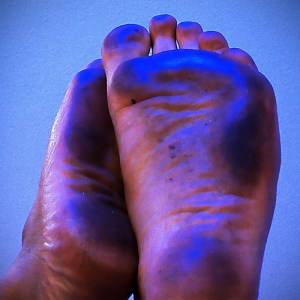
Below is a before and after shot. Well not exactly. Steve suggested a before and after and I’d already noticed changes in my foot so my friend Rhys who has the exact size 11 flat and similar pre-barefoot physique as me volunteered for the shot.
Before Shot Using Look Alike
A. Low muscle mass and definition
B. Weak forefoot pad
C. Undefined arch muscle
D. Swollen puffy ankle
It’s not that bad it just like making fun of my mate’s foot.
Yes yes. They’re not the same foot. Take my word that my foot was in pretty bad nick too. The point, is your foot is like any other part of your body and can be shaped and strengthened for performance.
3. It’s a Zero Sum Game
I’m not an “All or Nothing” kind of guy. But when it came to going barefoot it was clear I had to decide. It was too disruptive flipping between arch support and none. Besides I’d been flipping my whole life. Barefoot around the house wasn’t fun. Sunday mornings? Shoes came on after an hour or two. Too many friends have had me answer the door with sneakers and boxer shorts first thing in the morning. Their perplexed glance returned with a you don’t understand look. My body needed a stable adjustment path for once in it’s life and after testing my once loved orthotics after 3 weeks barefoot, it was apparent it would be the last. They felt wrong and were reversing my transition.
4. Know Thy Foot
A big personal realization is the foot is jam packed full of muscle (who would have thought?!?) and like any muscle it can change in capacity when trained with purpose. My belief, is one can exercise their foot muscles, realign tendons/ligaments and reset nerves to make the arch stronger as any “normal” arched person. In essence growing your arch. O.K adults may not get that “sexy half mango” look but you can get mass and strength. If you don’t have a legitimate fallen arch then you likely have a flexible flat foot which means you can make those feet ripped!
Super Tip: If an arch develops when you stand your toes on one leg then your flat foot is flexible and you are ready to rock.
To truly understand what your dealing with you must see it first hand. Though this next video is somewhat macabre it provides insight on how the foot works, see the actual arch and help visualize it when you start putting it to work.
Start at the 9:00 minute mark, it takes you to the goodies. The abductor hallucis (arch muscle) and Flexor hallucis brevis (Big Toe Pad Muscle).
5. No Pain No Gain
The four most addictive things in the world are heroin, carbohydrates, a monthly pay check and arch support.
When one gives up an addiction there is discomfort involved. Agreed, orthotics are more a dependency but I wanted to mash it in the above quote.
Many experts on the subject is going to say ” If it hurts stop take it slow”. Most of them are referring to more the running than anything else. Look… when a lifer arch support user (i.e. me) goes cold turkey they ain’t going to be running. They’re literally learning to walk again and there is going to be pain. Your body will ache, knees will creek, self doubt will linger, it will suck and all you want is to go back to that warm place of adjust-mental bliss. Kind of a like an ex-girlfriend until you quickly realize why they are your EX!
If you are going through hell, keep going – Winston Churchill
It took me 4 weeks to get through my pain wave and instep withdrawal. For some it may take longer. Embrace the suck – but if you’re walking, stretching and resting and it still hurts especially in the feet then rethink your approach.
6. Code Slow
The biggest mistake people make when going barefoot is forcing change and not letting their body adjust naturally. Normally, it’s because people want to start running barefoot and though they have good arches a 1000 other parts need to adjust too. Walk it out big fellas. Ride the bike too. Take the bus. You’re going to be hurting anyways..don’t make it worse.
Code Slow! Walk, Rest, Stretch, Rest, Walk.
7. Learn to Walk Again
Special Story Time: Recently I caught up with my close friend Ov. Ov sees it as it is and does it with out fan fair or self promotion. Noticing he was wearing flats, I asked with a sneaky suspicion whether he is flat footed. “Yes, I wore orthotics up until 5 years ago then got jack of them”. What did you do after? I asked. Ov responded “learnt to walk properly“.
Did you notice the perfect gate on the computer model above? Apart from thinking chaos and neural network theory is cool it was the only example of a gait to strive for (pardon the pun). I couldn’t find one real life example of a normal gait video. It’s been explained to me by a podiatrist just no example. Maybe its because footwear is recking our gait?!>!
Spontaneous Content Outbreak – The above thoughts forced me to shoot what the podiatrist showed me. Pretend my hand is a foot and my pointer finger is the big toe. Basically it starts with landing on the heal, roll along the outside of the foot then push off directly forward with the big toe. In theory this is a normal gait and what my arch supports helped me do with out thinking.
8. The Long Walk
Don’t run. Grab an audio book, walk, walk and keep walking. Walk like someone is behind you with a shotgun and if you stop they’ll blow your head off and if your last person walking you’ll go to a place full of virgins with professional ballet dancer arches and you are the arch king with arches that go all the way to your shoulders.. How ever you do it. Walk Forest Walk.
On my first walk, I walked about 400 metres before turning around because it got hurties. Every couple of days I could walk a little further. I focused on posture, dropping the shoulders, my hips naturally start to tilt backwards, I bent my knees a little more. I let my feet roll just like they did with the insteps just like the examples above. Then everything would get retarded and I would have to re-focus. A continual test of focus and conscious anatomical manipulation. Some of it will sink it into my subconscious other parts won’t. Walking is our birthright. Two feet and a heart beat baby!
9. Lack of Stretching – The Achilles Heal
After years of arch support those Achilles are going to be frigging tight. Stretch them and the calves as much as possible.
10. Do What Ballet Dancers Do To Strengthen
If there is any community where foot fetish is the norm then its Ballet. Strong arches are highly valued, flat ones are scorned, bitchyness is expected and creepy feet licking trolls are just around the corner. To save you the drama, below is the better of the lot and covers 101 exercises.
[Tip] Drive weight through big toe to strengthen the abductor hallucis and Flexor hallucis brevis.
If you have time and discipline the
Theraband seems particularly effective and popular with the dancers.
11. Lose Weight
If you want to give your skeletal-muscular system a fighting chance to adjust with less pain and reduced chance of injury then drop the weight. Even being average or under weight you still have a chance of permanently messing yourself up. Flat feet or not going primal requires a primal body which means lean….really lean.
12. Massage
Happy Days Before an Excruciating Chinese Foot Massage
If you can afford it a regular Chinese foot massage then do it! Otherwise buy the best therapeutic piece of equipment known to man the Foam Roller and start working those calves.
If you are yet to carry a foam roller like a rocket launcher I advise you start.
13. Shoes, Shoes, Shoes
Running the Shoe Gauntlet
As you can see above I’ve had my fare share of shoes. I like to trail run and I like shoes too. Since going barefoot I’ve realized the best shoes are none at all.
1. New Balance 904
Standard trail shoe.
2. Nike Free Run
My first shoe which simulates “barefoot”. Huge heal drop. Wore for 2 weeks. Don’t buy if you are serious.
My favorite barefoot shoe. Unlike the trek the sole is a couple mills thick and felt the most barefoot out of anything I wore.
5. Vibram Five Fingers TREKS
Like the KSO, except for a thicker sole and warmer kangaroo leather upper. I’ve found them restrictive because of the dense sole. Still best for trail as it protects from sharp rocks.
6. Terraplanna
My favorite office shoe that you can run in if you want or need to.
For reviews on the explosion of barefoot shoes go here.
It looks easy on paper but when you have flat feet the decision is daunting and it is a real risk. If you take the leap you have to commit and follow through, there is no turning back. Based on new research emerging every day the odds are in your favour. I’m realizing the benefits and let’s not forget the mental freedom of not depending on a device to control how I move. Watch out Youtube ballet brats I’m going be in the house soon show’en my sunken yet ripped arches!!!
This weekend, I attended my first Rails Camp. I’ve been lucky enough to observe the Rails community from afar for the past 4-5 years through my good friends Pat Allan, Nathan Sampimon and others from the Inspire9, Melbourne and Sydney communities. I’ve always been impressed, and a little envious, of the apparent fun, engagement and progressive collaboration these people seem to share with others all over the world. Now, I’ve gotten the chance to see it up close.
I started learning Ruby on Rails about 8 months ago. I wanted to learn how to code, because I’ve begun to want the ability to create useful ‘things’ from the large number of API’s that the social web now provides. Also, Rails is very much symbiotic with the idea of Test Driven Development, which means writing tests for your code before you begin actually writing the code. It’s a brilliant methodology and something I’d like to see move over into the broader business and product management worlds.
I found the Rails Camp experience fantastic, if not a bit confronting at first. Even though I knew quite a few people from the Trampoline, Inspire9 and Melbourne/Sydney startup communities it’s a different feeling to being in the same large room together with everyone staring at their Mac’s. But I sat down, got stuck in an started building a little app which will manage how you borrow books from the new Inspire9 bookshelf. We finished the very basic app on Monday morning, at about 2am and I’m excited to see it deployed sometime in the next little while.
I’d like to send a huge thanks to the guys that patiently paired with me over the weekend; John Barton, Pat, Nathan and Richie Khoo. Each taught me something a little different and began exposing me to different ideas, for which I’m hugely grateful. I probably won’t grok most of it for another few months, but being exposed to it has been amazing. Thanks guys!
So now, the challenge is to continue learning Rails a little bit each day. Until the next Rails Camp!!!




You must be logged in to post a comment.