
I’m at Railscamp, which is fairly exciting. One of the core things about this event is that there’s no Internet access provided. So, I’ll be taking a 2 day break from the blog. Enjoy your weekend and see you on Monday!
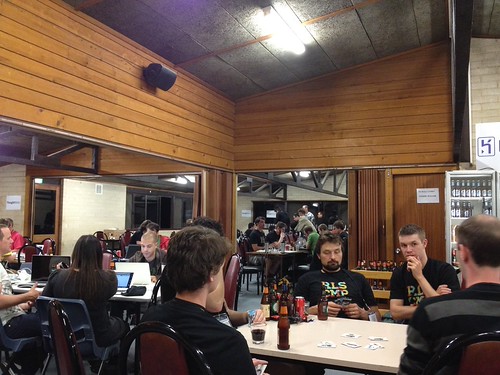
I’m at Railscamp, which is fairly exciting. One of the core things about this event is that there’s no Internet access provided. So, I’ll be taking a 2 day break from the blog. Enjoy your weekend and see you on Monday!
The internet is a pretty amazing place. Yesterday, after posting about the West Wing and the idea of Post Hoc, Ergo Propter Hoc, Katy Stevens pinged back with a tweet that she was pretty close to writing slash/fan fiction. I haven’t really investigated fan fiction that much; I used to know someone who read the Harry Potter fan fiction religiously whilst the final books were being completed. I’ve also read some of the Star Wars books when I was younger, which deal with following the characters from the films after the final episode. It’s an interesting concept.
@katyste @stevehopkins I don’t know what slash fiction is, but it sounds dangerous.
— Donna Moss (@donnatella_moss) January 11, 2012
Anyways. The characters continue to share dialogue amongst themselves on Twitter and it’s fairly amusing to see it all happening. The characters actually follow current events and comment about it to each other. Recently, Josh Lyman has been discussing Mitt Romney’s run for President and the Republican nomination. It’s one of the more clever things I’ve seen. I’m not sure who is behind it, but I applaud their efforts. A.May.Zing.
There’s a good list of the characters that are on Twitter in this article.
I was watching an episode of the West Wing the other day and was reminded of the saying “Post Hoc, Ergo Propter Hoc.” The saying essentially means this:
Post hoc ergo propter hoc, Latin for “after this, therefore because of this,” is a logical fallacy (of the questionable cause variety) that states, “Since that event followed this one, that event must have been caused by this one.” It is often shortened to simply post hoc and is also sometimes referred to as false cause, coincidental correlation, or correlation not causation. Wikipedia
Since catching that episode a few nights ago, I’ve been reminded that this is actually a core understanding when it comes to complexity and chaos theory. In chaotic situations, Snowden tells us that the only way to manage yourself is to react against the situation and see what changes. It is _not_ to assess the situation and then to make a change based on that. Act. Sense. Act Again.
We might see this in places where we assume that something is happening for one reason. Logically, we think, the sun is rising today because it did yesterday and so too the day before that. But perhaps that is not always the case. Perhaps we’re just seeing an order of events that makes us assume that. Bill Gurley wrote a great post about it recently, with regards to diets, where he explains this really well.
It’s reminded me to stay aware of what I assume is happening, and to be conscious that I may be inferring something incorrectly. It’s also reminded me why I love the West Wing so much! Happy Wednesday 🙂
I’ve been thinking lately about the concept of Commanders Intent, and why it’s an important concept to keep in mind when thinking about how you service your customers. None of this is new, but it’s one of those ‘always green’ concepts that I thought bore importance to mention again. Chip and Dan Heath explained the concept of Commanders Intent really well in their first book, Made To Stick.
Here’s how I define it:
It’s pretty simply the highest level of action you need to express to get a job done.
As an example, instead of an army Commander saying “we need to get the tanks, load your guns, run 20 meters, confront this enemy, plant the flag” etc etc, it simply says: “We need to take the hill.”
It then assumes that the people on the ground will know best how to take the hill, and that they’ve been trained to efficiently do that. How to train and coach your staff to be that autonomous is a topic for another day. That’s pretty much what I’ve been blogging on for the last 4 years 🙂
Here’s how wikipedia explains Commander Intent:
“Commander’s Intent (CSI) plays a central role in military decision making and planning. CSI acts as a basis for staffs and subordinates to develop their own plans and orders to transform thought into action, while maintaining the overall intention of their commander. The commander’s intent links the mission and concept of operations. It describes the end state and key tasks that, along with the mission, are the basis for subordinates’ initiative.”
To me, it’s important because the reality is nobody completes the same task the same way every time. And the truth is, robots will do tasks like that soon anyway. Things are too complex and to chaotic for any strategy to survive contact with any customer and that’s the way it should be. Providing value to your clients and customers through understanding the intent of their relationship with you is the core responsibility of your organisation.
I’m pretty excited to be heading along to the famous Rails Camp again, which is on this weekend. It’s in Adelaide this time, in Piccadilly. I’m not much of a engineer, but I’m looking forward to once again trying to get my head around the aspects or writing code in Ruby. I haven’t managed to keep up the practice since last time; in fact I’m sorry to say that I haven’t really looked at too much code in the last 4 months. So, to get my head back into it, i’ll probably take a tutorial or two along and work towards getting something fairly simple ‘pushed’ again. Learn to code, indeed.
One other thing I’d like to work on would be finishing the application that manages the Inspire9 bookshelf. Nathan and I (and many others) got the backend of that working at the last camp, but it lacks a front end. Let me know if you’re keen to help me out on that in Adelaide – I’d love your help! 🙂
Finally, Yammer will be officially sponsoring various parts of the camp this year. Namely, the coffee (!) and the bus ride to camp. If you have any questions about the Yammer platform, or working for us, then I’ll be around to answer such questions all weekend. Come say hi!


You must be logged in to post a comment.