Achieving peak performance by pushing your edge

It’s been a busy day. It’s 11:40pm here in Brisbane as I write this and Ross and I have been spending the day meeting and working with some of our clients here. It’s been great fun and we’ve learnt a lot from the experience, as we always do. The sheer velocity of the workload of the moment is something we’ve discussed and something I’ll chat about in a future post.

So for today, I’d like to share the thoughts of Dr Lex Bertrand and how he coaches olympic athletes to achieve peak performance. You can read the full article here.

“…I simply want to gain the satisfaction of seeing people achieve at levels beyond contemporary expectation.

Of taking the sport of sailing to new and previously unimaginable heights.
You see, I ask them to step out of the framework of the norm, and jump into the realm of the astounding.

Yes, I do ask my students to sail backwards.

I’m very kind – I let them use the rudder for the first few times until they get the hang of it …

The concept of sailing backwards is anathema to many old salts. With the general configuration of a boat and its sails, it really should not be achievable.”

This is old content – it’s been around since the Mindful event last year, but my thoughts often come back to it. How are we training for peak and epic performance? How do we translate the idea of sailing backwards into our modern, every day life? What are we training for?

Enjoy.

Peter Thiel on the freedom to leave

I watched a video interview with Peter Thiel today, which you can see below. Peter was the founder of PayPal and the first investor in Facebook. He’s also someone very keen on studying society and philosophy, which is what this video touches on in an interesting way.

One topic of conversation I found most interesting was the discussion around why giving people the freedom to leave something actually helps that thing be better. With the knowledge that people can leave a system, comes the recognition that they are choosing to stay.

“The freedom to leave is one of the most fundamental freedoms.”

Further to this, our ‘right of exit’ has greatly expanded as a people in the past 50-60 years, which is an undercurrent to many of the systems Peter has been involved in building. As an example, PayPal provided a way to exit the troubles of transacting and transferring money on the internet.

Don't plan. Be prepared.

I’ve been following many of the people undertaking the blogging challenge this May, what’s come to be known as #b03. One post stood out to me just now as I was reading it, by my new colleague Sarah Fosterling. She talked about how living a life where you were a little bit lost was better than living one driven by goals. Check it out.

It immediately resonated with me, in a similar way to David Hood’s post about the man who points at the moon. We focus so much sometime on the finger, that we miss the very thing that it’s pointing to. Brooke Sachs also posted a beautiful piece earlier this week talking about death and how most of us are all really unprepared for that momentous moment in our lives.

They reminded me of something the wise Peter Spence shared with me once:

“Don’t plan. Be prepared.”

@pspence5 gettin started on play at #mh20

It came from a conversation we were having about goal setting, which I was leading. I thought I needed some goals at that time – not long ago, just before I started working at Yammer. His comment stuck with me and remains present in my thoughts when I’m thinking too much about what I hope will be. His thoughts were that creating goals often ultimately limits the possible and potential of the creative mind.

Instead this year, I’ve resolved to not make more plans but create habits and learn how I do that. We all form habits differently. For me, it’s been my resolve to blog more and do that daily that has been my goal. However, that doesn’t mean that I’m not able to express my creativity through doing that and go where the wind takes me. Hopefully, building those habits will lead to where I’m always prepared to go where I’m taken. As Sarah says, we’re can never really be sure where our journey will lead next. Being prepared for whatever comes next is far more critical than having a good set of goals.

Creating and testing a #leanstartup value hypothesis

I’ve just recently finished Eric Ries book, The Lean Startup, and wanted to try and unpack one of the core concepts in that better than I previously have. This core concept is the idea of the Value Hypothesis AND the growth hypothesis.

There are two varieties of hypothesis?

I’ve read and followed the #leanstartup movement for a couple of years, reading many of Eric’s posts on the subject and attending the Lean Startup Circle events here in Sydney through most of 2010. However, we (or perhaps just I?) always seemed to be attracted to the more shining lights of the method…The MVP. The Pivot. The vanity metrics.

These things are important, but reading the book has highlighted some of the more subtle and crucial parts of the method that I missed in the first few years. Especially, Eric seems to present us with the idea of the Growth Hypothesis with more clarity than previously in his blog. Others agree with me on this.

So, the framework begins to look something like this:

1) I have an idea
2) What will people find valuable about that? (Value Hypothesis)
3) How will we grow the business and find more customers? (Growth Hypothesis)

In this post, I want to focus on the Value Hypothesis. I’ll cover the Growth Hypothesis later.

The Value Hypothesis

The value hyptothesis is probably best defined by Eric himself.

Value Hypothesis

Essentially, it’s what you understand will drive the customer to want to buy or use your product or service. What is the value that people will get from the thing you build?

Importantly, though, it’s how you go about testing this hypothesis that really matters. I wrote a post a while ago about forming a hypothesis and that still rings mostly true – the thing I missed was how this leads to success and the important of defining your baseline metrics to understand when you’ve learned something valuable.

Step 1: What’s your value hypothesis?

The first step would seem to be defining what you perceive people want or need. An example I can talk about is the app I launched last year, Smo.ulder.in. Smo.ulder.in provides people with an export of all content from their Campfire chat rooms. I realised this was a problem when I myself needed to export everything for compliance reasons and wasn’t able to.

The value hypothesis in this case, was that people would want to download their content to have a separate place incase of being audited or canceling the service.

Step 2: Compare to your baseline metrics to see if you’ve learned anything

After 1 year of slow learning and about 30 customers later, I’d say I’ve proven the basic hypothesis. That people do want to download their stuff and they are willing to pay for it. The problem is, I haven’t been able to gauge my success that much because I didn’t have any idea of the baseline results I wanted to see. Is 30 enough? Should it be? I didn’t think through this at all.

This is another aspect that has jumped out upon reading the book again. It’s simple, but I didn’t appreciate it enough when I first worked through the #leanstartup stuff. If you don’t know what success looks like, it’s hard to assess whether you’ve actually learnt anything. Now, smo.ulder.in has broken (the API changed) and I’m unsure of what to do with it.

Step 3: Build the MVP

Campfire didn’t offer that feature, so I decided to commision Pat to build it. I wrote a post all about this when it happened. I was pretty happy with the quick launch and turn around and enjoyed actually seeing people use the service. We got people using it and testing out value hypothesis.

Learning how to learn about your progress is the most important thing

In closing, I’ve learnt to appreciate the value hypothesis much more and plan on using it in my work and other projects. Asking myself what value I believe I’ll be providing ahead of time and then outlining the baseline metrics I expect to see move are things I’m going to work on. Creating an MVP is the fun part and something I’m more familiar with but learning how to learn about your progress is thing which has stuck out as most important after reviewing the book. It’s from there that you can pivot or tweak your growth hypothesis to continue developing your idea.

It’s also worth stating that you don’t need to be applying this framework to just online startups. I’m going to begin applying it to my blog, to better learn the framework and the value of following it.

How to start a coworking space…like @homework66

This is the third and final post in a series I’m writing about coworking spaces and how to start them. Here’s the first piece on Inspire9 and the second piece about Hub Melbourne.

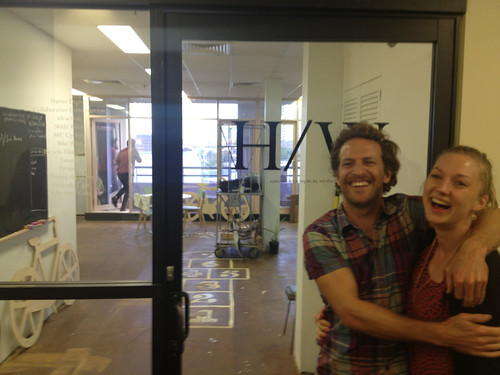
Home/Work is the new coworking space in Sydney on Oxford St where I have been basing myself for the last month. I’ve already written a post about Home/Work, back in it’s first week so I encourage you to check that for more information about the space and where it’s located. I’d like the focus of this post to be how Josh, the founder, went about starting the coworking space and how he managed to go from a completely empty space to one that’s almost over-subcribed in 2 weeks. The secret to this success is, I believe, in the way Josh launched the space and kept things small as he started up. In this way, it’s similar to how Inspire9 opened up in Dover St before their move into the bigger space in Stewart St.

Email your friends and solve a problem

My first contact with Josh actually came through twitter and this blog and the post I wrote about working at home. Lauren, Joshs’s partner in crime, tweeted or emailed me and said that he might have something in the works for the new year. I replied that I was very interested. Sure enough, come early January Josh emailed me and said he’s managed to secure a space in the old Oxford Street offices and was creating a coworking space in it. I was very excited. The email was a group email, I assume probably to a group of about 30-40 people. But they were all very close contacts of Josh’s – people he’s worked with or collaborated with before. And if you know Josh, you know that he’s a very lovable and enjoyable fellow to be around. His email would have been well received. I shot him back an email saying I was in.

IMG_0352

From email to open in one week

One week later, I was in the space working for the first time. Josh worked around the clock with his own special DIY abilities to get Home/Work ready for people to work productively from. He borrowed wifi from a neighbor for the first week or two, built desks out of scrap wood and fashioned a meeting room table from a disowned door. He had help creating funky typography on the floor of the space, to give it a playful feel and then painted a blackboard onto the wall. He even has the Mayor, Clover Moore, in! Job done!

josh and clover

Payment is simple

After the second week, it was already apparent that the space was full and there were no more desks available. You can still drop in for a few hours at a time or maybe a day if you time it right and Josh is happy to keep it fairly basic in terms of pricing. If you’re going to be around for a few hours, then you can drop by but if you’re making a habit of it then you’ll need to pay. For the early crew involved, these guidelines are pretty self-evident and observed pretty well. This has made it easy for people flying up from Melbourne to drop into as well as other friends of Home/Work members to drop in for a bit of working time.

The concept wasn’t over-cooked

This is what Home/Work has done very well. The concept hasn’t been over thought. There are desks and there are people. That’s about all you need. Josh is slowly filling out the space with the more useful amenities like a microwave, wifi and spare keys but all of those have only been sourced as there has been a need. It’s a lean operation, and so it gives Josh time to work as a consultant whilst still operating the coworking space. All this has led to an enjoyable place to work where everyone has a growing level of ownership and comfort.

What Home/Work has done well

1: Didn’t over complicate things and just invited people to come via a direct email.
2: Worked quickly to allow people to come into the space. They haven’t lost time worrying about things that don’t matter (yet).
3: Has an open vibe too, with a fairly simple payment philosophy. That is, ask Josh.
4: Didn’t get too caught up with the community activities that are possible in a coworking space. Home/Work provides the basic foundations for what coworkers are looking for – A desk and some room to work, every day.