Holding on tight

Holding on tight

I hold on too tight. I’ve had a somewhat personally frustrating month and I’m not quite sure why. I think it’s been mainly frustrating because I’ve felt powerless, perhaps thinking I’m owed too much or that ‘things’ are against me. I’ve recently taken this out on those closest to me, the ones I’ve loved most. It’s a strange sensation.

This week Edward Harran, Janet Hopkins and I ran the Mental
Health Unconference
and I was reminded again of how sometimes I hold on a little too tight. My dedication to my own scope and ideas, sometimes caused me to miss opportunities for greater depth and understanding.

Holding on tight

Ross reminded me of this even tonight, when I was holding back posting a blog post announcing the Awesome Foundation Sydney founding board. Even then, I held back to maintain power over what I thought was best. 

“Wait till tomorrow,” my inner ego said.
“More people will see it then.”

I’ve always meant to put up a post about a question Rose and I discuss often: what holds you back? 

In these times, where there is uber-complexity everywhere it’s a helpful little reminder to me about remembering that crucial question; what holds you back? In an agile sense, it presents itself in one of the three questions asked in every huddle – what’s blocking you from achieving the next action item?

I’ve always held off writing the post, because I could never think of what it was that *actually* held me back. 

Now, I think I know. I hold
on too tight.

We live in probably one of the luckiest positions in this planets history. Never before have ‘humans’ controlled our domain so well, and not since the dinosaurs has a species so completely conquered the earth. Global warming aside, it’s a bloody great time to be alive and there are a fantastic crew of people here to be a part of that with. It’s no cake walk, but I wouldn’t want to swap my tickets for the show we’re seeing now for anything.

So what holds you back? What are you holding on tight to? What would happen if you let go? If you embraced simplicity over chaos and trusted in your own resilience? I’m gonna give it a go. I might even join Xavier for his Mindful March and see if that helps at all. It certainly can’t hurt.

So, what holds you back? 

How I Built An Online Community Using Lean Startup Principles

This is a guest post by James Spittal, who is an Entrepreneur and Web Marketing Consultant in Melbourne, Australia. He is the founder of Merspi for VCE Students and the Lean Startup Melbourne group. He is also the Managing Director of Fast Fast Websites which provide lean web marketing solutions to small businesses. You can follow him on Twitter at @jamesspittal or on Facebook.

It was 2009 and I was undertaking some electives in Entrepreneurship at Swinburne. As many businesses start, I started with a simple question: “What is the product that I wish I had (as a user or customer) several years ago?”

Taking yourself as the target market for your business venture puts you in a position of power and true understanding — knowing their real pain points and being able to relate to the customer is a real competitive advantage and often a good starting point for the solo, bootstrapping Entrepreneur.

I eventually came up with an idea for an online learning platform for VCE students. It was a kind of Blackboard competitor – online tutoring that schools would buy mashed up with an intranet based collaboration and Web 2.0 philosophies.

merspi screen shot.

It came from several pain points I had as a few VCE student:

  • Severe lack of content related to how to succeed in VCE (I remember googling VCE back in 2006 and finding literally nothing that was context specific to VCE.)
  • Tutoring is expensive (Often as high as $80/hour)
  • Textbooks suck!

Lesson #1: Customer Complaints = Opportunities

One of the first things that our Entrepreneurship lecturer wrote on the board was “Customer Complaints = Opportunities.”

In other words, the “problems” that people may see in the industry or the market as it currently stands often lend themselves to exceptional business ideas if re-framed as business ideas.

We took the problems we had identified with the VCE schooling system and asked the question: “How could we fix this?”

This lead to the idea of the online learning platform for VCE students.

Over the next twelve weeks, we wrote the business plan and work-shopped the idea with the help of lecturer.

Lesson #2: Don’t Be Afraid To “Pivot” & Listen To Customer Feedback For Hints

We started with a basic idea – online video tutoring for VCE students that schools would buy. Our first test involved talking to some lecturers (experienced mentors) and potential customers of the product.

After several months of schmoozing, hard work and rejection on the phone, we managed to get a meeting with a few schools and managed to convince them to give us an hour of their time. After only one or two meetings, we soon realised that our idea was unlikely to ever be something that schools would pay for.

“This isn’t going to work,” we thought. This raised the question: “How could we make it work?”

We went back to the drawing board and started again. This time, we took on board all the feedback from our customers (schools): “Schools don’t have money to pay for this kind of thing. Neither do students.”

OK – what if we could find a way to do it so they didn’t have to pay?

This is where the idea to run Merspi as a free Question/Answer site came from. “But what about the other sites out there where VCE students may be spending their time?”

We soon realised there were some major problems with each of these sites that we identified. We surveyed some VCE students to find what they thought about the whole thing. The feedback was overwhelming. There was a big demand for information but there was an extreme lack of supply that could be found via Google and similar search engines. However, it was an interesting market because although the demand was high – the students typically didn’t have money to invest in their own education so the large corporations in the market were also struggling.

Lesson #3: Stay Lean: Keep Costs Low & Start Small

Our first attack at this market according to our business plan was going to be to raise a large amount of money and get the website built for around $100,000. This was far from lean.

After a lot of failure at trying to raise six figures worth of capital with no experience and no track-record of success, we gave up. But I was not disheartened. I knew that I could put something together myself… leveraging my own skills. I knew that it would take a lot of time but time was the one resource I had in plentiful supply at that point.

A slab of red bull later – we had a working product. Our total costs from idea to implementation ended up being less than a few hundred dollars. The majority of our start-up costs for the three months were spent on SEO, marketing and essentially ‘buying’ the attention of as many VCE students/schools as we could in the hope that the community would grow and catch on in the early bootstrapping days.

Early Merspi
Above:An example of an early version of Merspi

In the end, our total start-up costs were less than $1,000 and about half of that went towards attending the largest VCE conference that was out there (marketing).

Lesson #4: Watch Your Analytics For Hints To See How You’re Going

We noticed an interesting thing with the Merspi.com launch. We had an impressive amount of traffic practically from Day One. We didn’t start with a list of VCE students or have any great networks in the field. The traffic that hit the site in the early days – the majority spent a very long time on site (over 10 minutes per visitor) and there was a high level of user engagement.

You could say this was our first serious test. This was the first time we validated our hypothesis that this was what students were looking for. The validation increased over coming weeks as the traffic grew steadily.

Lesson #5: Understand The Numbers and Metrics

We knew that a key metric for the success of our online business was going to be traffic, number of users and the number of questions asked per day. Hence, we set about creating a plan to track these numbers on a daily basis and created short “feedback” loops to improve them.

One example: we invested in Search Engine Optimization (SEO) and link-building over a trial period of a week and measured exactly how much extra traffic this caused on the site in order to test our return on investment (ROI) of Marketing Spend vs Increased Traffic.

Lesson #6: The faster you can learn in business (Information, Metrics, Customer Information)… The better your chance of success.

We used tools such as KISSmetrics, KISSinsights, User Testing and Google Analytics to survey our customers and constantly try to better understand them. We also did the old fashion method of going out and talking to VCE students.

The most important principle of the Lean Startup Philosophy that made all the difference in Merspi making it from idea to implementation and becoming an eventual success (albeit, a slow and sometimes painful one) is the principle that Dan Kennedy calls: “Seek the swift blade” and Eric Ries calls “Fail fast, fail often.”

In other words – “failure” unto itself in business is not a bad thing. We could have taken the initial meeting with schools all saying no as a sign that we should give up.

Instead, we took it as feedback that we should keep the core concept but modify the target market slightly. We integrated the learnings and key complaints from the school target market which was ‘we don’t have any money’ and found a way to deliver the same quality content without having to charge for it to be a sustainable model.

A common saying amongst Neurolinguistic Programming (NLP) practicitioners is “There’s no such thing as failure, there’s only feedback.”

Exploring Mindfulness

There’s a spate of great people coming together and projects happening at the moment that circle around the idea of Mindfulness. I’ve certainly gained a lot of value from studying and practicing being more mindful, albeit sporadically, in the past few years and would encourage others to engage with the topic. 

One such project is Mindful*, which is a conference being run by Ross Hill and Jan Stewart later this year. You can still buy tickets here, but get in quick.

I’m really looking forward to going, and wanted to post about my thoughts on mindfulness. I wanted to share a quick story about one recent moment which helped me further understand what it is all about.

Beach Meditation

A couple of months ago I had the privilege of joining Jan for a coffee and a chat in St Kilda, to discuss what it means to be mindful and also to share in some meditation. She writes a great blog and can often be seen tweeting and #deepdiving, which is what I wanted to find out more about in our chat. The very idea of a deep dive sounded alluring.

Over coffee, we discussed my current approach to mindfulness. I had meditated before, but not consistently. Whilst I had a good awareness for moments when I was being unnecessarily distracted or impacted by extrinsic things, I was prone to some intrinsic anxious moments, caused by my own mind wandering away on its own. I’m sure we’ve all had these; moments when that little voice in your head gets carried away, just before hitting the red button. 

We talked about how, when studying mindfulness, we sometimes get carried away with forcing ourselves to “think of nothing,” which of course defeats the purpose. If you’re focusing on thinking about nothing…are you really thinking about nothing? 

That was quite a revelation for me.

We then moved over the road, to the beach, and simply sat on the bench you see above and meditated for a time. One thing that was hard with sitting on that bench was the number of people that move inn front of you on the bike track, zipping to and fro on their bikes, rollerblades and other conveniences. 

I found I was being easily distracted (or focused) on the movement happening there. Suddenly, a stiff breeze whipped through. This happenstance alone helped me really grok what it was Jan was talking about over coffee. The wind was something that I was missing, because I was too focused on trying to ignor the bikes.

In life, sometimes we can’t help but be drawn to the movement and energy which surrounds us. When someone asks you the question:

“How busy are you at the moment?” we can’t help but reply:

“Oh yeah, pretty hectic at the moment!”

We wear it like a badge of honor. But this ‘bustle’ is actually only helping you miss the obvious. What is it that is right in front of you, right now, that such movement might distract you from. For me on that day, it was the bikes and rollerbladers. In every day life, it may be anything. The wind came through and helped me realize there are things I’m missing, if I’m open to them. And, once open, the experiencing of actually feeling all of those previously unknowns _is_ the experience that meditation is great for.

I get a sense that mindfulness is just that. It’s about opening up your awareness to everything that may or may not be in your current consciousness. I’m looking forward to investigating it more at Mindful* and look forward to hopefully seeing you there. 

Creating smo.ulder.in to export campfire transcripts

Recently, I needed to export a lot of stuff from campfire – about 6 months worth of chats. We used Campfire to host our daily huddle chats whilst we were developing an internal product with Pollenizer recently. They decided to depreciate the service, and I was still keen to get the notes from that for posterity.

However, I was disappointed to find that Campfire didn’t support a bulk export function, only the ability to download the notes from each days sessions.


I had a bit of a hunt around, and luckily found Emil’s response to a different thread post on the Campfire forums. I’ve recently turned my hand to trying to learn and use the programming language, Ruby on Rails. But this was still beyond me, so I headed to the Inspire9 Yammering community and asked there if anyone was able to take up the challenge.

The Inspire9 Yammering community contains some of the best Ruby guys in Australia, not to mention some of my best friends, and it’s a good example of what you can achieve using the Yammering system. Whilst we don’t all specifically work for Inspire9, we certainly do all belong in that community.

Much to my pleasure and thanks, Ben Hoskings and Pat Allan took up the challenge! You can see the conversation here…

Yammer Discussion re: smo.ulder.in

Soon, Pat and Ben had a solution for a script that would export all the info I needed, which you can see here.


Gist of Smo.ulder.in version 0.01!

After all of this, I felt like it was a great opportunity to build the app into something anyone could use, rather than just those blessed with the ability to write Ruby code. So I commissioned Pat to build out the script into an application that would allow someone to export all of their campfire rooms.

And now, not even two weeks after the initial question – we have the solution! Let me introduce you to http://smo.ulder.in, an app anybody can use to export all their conversations, attachments and knowledge out of a campfire account.

How to use 99designs

I’ve used 99designs a couple of times now as a client, having creative work designed for me. In those two cases I’ve picked up a few hints and tips, which I though would share with you. In this article, I’ll highlight why 99designs is now my first port of call if I need something designed, and why. I’ll also highlight how to elicit the best responses, and share some behind the scenes screengrabs to show you what you’re in for if you do decide to launch a contest.

How to write the brief

The brief is how your campaign starts. It’s what the designers will refer to and use to begin their work, so make sure you make it very simple and clear what you’re after and how the design will be used.

99designs brief

In my briefs, I tried to give a very clear scope about the direction I would like the design to go in. Having said that, I also provide lots of room for the designer to be creative. Check out the briefs for the new blog design, and the logo design which I ran last year.

Pro Tip: Share links to photos, websites and other things online that represent the feel you’re trying to capture with your design. You can see in both my contests that I shared some inspirations, even though they had nothing to do with the actual outcome I was wanting.

Make it clear what you DON’T want in your design. Designers love this, because it let’s them know what they can avoid and thus save time.

Nothing is worse for a designer than pouring their creative heart into a design, only for the client (you) to turn around after the work and reply that you didn’t want those specific traits. Great designers love restrictive scope, and these are the ones you want to attract with your brief.

Pro Tip: You want to get these talented people started with your brief. Know that you can tweak things during the feedback process later in the contest. Don’t panic if you can’t capture *every* amazing feature you want.

Finally, make sure you do check out what other contests are running when you’re launching your contest. You’re essentially in a contest with them to appeal to the best designers – designers who are probably coming to 99designs because they want to flesh out their portfolio a little bit, or earn some quick cash on a good design.

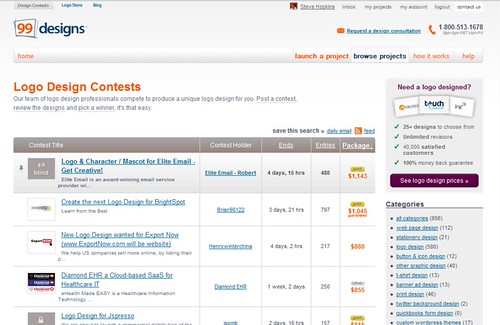
Pro Tip: Make sure you have a scan of the currently open contests before you title your brief. These are what you’re competing against for quality designers. Make sure your brief stands out against these specific contests. Matt Mickiewicz, the founder of 99designs, gives a good outline on Quora.

9designs contests

Should I pay extra for the special options?

This one is very dependent on the types of contest already listed when you launch your contest. I would advise to at least make the subject header of your brief title bold.

I would also encourage you to chose the standard rates, as 99design co-founder Mark Harbottle explains here in Quora. The more expensive contests will garner more talented designers, but the standard rates are good too. In both of my contests, I used the standard/recommended rate but bought extra promotion features – like bold text.

Pro Tip: Don’t be cheap. There are options to drop your price for the contest. Don’t fall for this trap – you won’t appeal to the serious designers, even with the most appealing brief heading. The standard rate is appropriate…if you’re not happy to pay that, then don’t use 99designs.

When should I launch my contest?

This is a tough one. With my first campaign, I launched it at 10pm (Sydney time) at night and awoke to 28 entries that were submitted whilst I slept, of which the eventual winner was one

I try to launch it in my local time when some people are still up (8-10pm, Sydney time) but where folks in the UK and US are getting in to their day.

Should I run a blind contest?

The first contest I ran was a public competition but because that was a logo design, protecting the designs of the contestants wasn’t so important. However, when I ran the blog template design contest, I um-ed and ah-ed about which was the best approach. In the end, I went for a blind contest and was happy with the results.

A blind contest just means that designers can’t see each others designs. It encourages designers to submit their work, knowing that it won’t be ripped off by other designers in the attempt to win the prize.

Provide Feedback on the designs you like

The last, and most important piece of advice I can give to running a 99designs project, is to give heaps of feedback. More importantly, give the feedback to the designers you can see have the best feel which is closest to what you want.

When you see your initial designs come through, there will always be one or two that really strike you. You’ll say “that looks really good” or “that’s close…but not quite it.” On these designs, provide the designer specific feedback about what you would like to see and then get them to post up the changes for you.

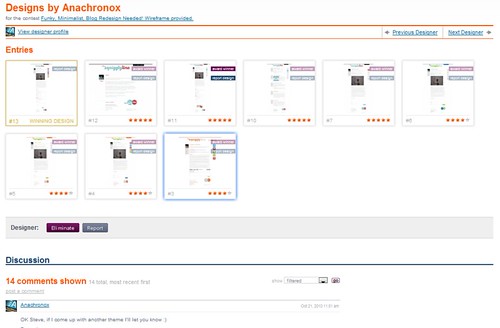
As you can see below, Anachronox and I had 14 comments back and forth, and he designed some 9 iterations of his first design. I had similar lengthy conversations with 2 other designers who were also very close in the beginning.

99designs feedback picture

For the designs which immediately don’t appeal, provide some feedback and let the designer know that you’re thankful for their contribution, but you’re happy with their submission as it is. Don’t string them along. Wasted time is brutal and if their design doesn’t appeal immediately it will take them too much work to redesign it.

When to announce the award

Finally, always wait until the deadline to announce the winner. You never know who will post something up and blow your socks off! However, once you’ve found a design you really like then really work with the designer to tailor it to what you need.

This is the real key to 99designs – don’t view it as a pure competition. View it as the chance to work with a number of designers at once towards getting what you want. Don’t be scared to ask them to improve on the work or to change things to get you closer to what you’re after.

Finally, make sure you ask for a variety of different colors and a black and white version of your design. This will just help you to ensure that your design will work in any setting, as well as when it is printed out.

What are your experiences with 99designs? Do you have any extra tips?