Thoughts from Trampoline.

Trampoline 3 was held this weekend, and I thought I’d share a few of the threads that really came home to roost for me during the day. I feel like trampoline helps me quickly grok concepts I’ve often wondered about as I listen and bounce thoughts off others in sessions. It exposes me to things I have no idea about.

Trampoline 3 (un)conference Melbourne, 2010-05-02 from Andy Gelme on Vimeo.

Some highlights for me yesterday were:

  • Rachel discussed technology in aged care, and raised some great points. One of which, was our obsession with ‘youth marketing’ – We now have Children, Tweens, Teens, Young adults and Gen Y. But then, when we get to older people, we simply say “+55!!!”. The average life expectancy in Australia is around 80 now…that leaves a large amount of people unaccounted for in our segmentation.
  • I enjoyed discussing the idea of wisdom, and found it to be a growing topic of interest. Thinking about the use of intuition in decision making is also something that was discussed, which I look forward to thinking and chatting more about.
  • Autism is an incredibly more complex topic than I could have ever imagined, and a prejudice I had without understanding why. Thanks to Daniel for the eye-opening conversation we shared in the ballroom in the afternoon.
  • Touch screen technology is fascinating, and I’m intrigued by the idea of these “horrible abstractions” (keyboards and mice) that we’ve all made do with since the birth of computers. Thanks to Keith and Cris for sharing their thoughts and ideas.
  • I’m so proud of Mum for sharing story of her illness for the first time in public.
  • The drumming and beat-boxing lightning sessions at the end really demonstrated to me the idea of inclusion. Every single audience member was only a single unit of a larger whole – in this case a drummer or a beat-boxer. Inclusiveness is upon us. Thanks to Michael and Jared for their creative conducting.

If you couldn’t make the day, check out the photos on the Flickr group, the videos on the Vimeo channel and the tweet stream on Twitter (before it disappears!). Finally, see the Google Group page for the names, contact details and topics discussed yesterday.

A huge thanks to the sponsors that helped make it happen on the day – Donkey Wheel, Nodecity, Pollenizer and Web Directions.  

And lastly, sign up to the mailing list at www.trampolineday.com to hear about Trampoline 4.

Being wise.

Being wise has long been a sought after attribute in humans in our society. For centuries, many ‘wise’ people have been lauded singly for such a trait. But what is wisdom, and how are we all working on being wise every day in our lives? Perhaps the kid in The Matrix said it best. Maybe there really is no spoon.

nospoon2.jpg

To me, wisdom I something that comes from observation. It comes from observation of ones surroundings and the interactions of others in such surrounds. It also comes from observing yourself, and being aware of your own emotions, reactions and intuition as you’re exposed to different experiences. Eckhart Tolle talks about ‘the observer’ in his books, which is a similar and related idea to being mindful in your daily activities.

Wisdom is certainly an interesting idea, and as Ross Hill made comment, something we almost certainly will never fully understand. It will be interesting to watch this weekend particularly, as two events which really inspire me take place. Trampoline is on again, which always fills me with wonderment and awe around the knowledge, passion and wisdom of many of the participants. I can’t wait to be amongst it again. And a new conference, Wisdom 2.0, is taking place in San Francisco (and at Google HQ) with the distinct ambition of discussing wisdom in the modern ‘2.0’ world. The speakers list looks amazing, and I look forward to hearing all about it from the Aussie contingent going.

I’ll be running a session at Trampoline this Sunday, hopefully calling in the guys at wisdom2.0 (if I can get a session early enough!) and I look forward to discussing more of the ideas and thoughts everyone has around being wise.

Don't force it.

There is a great scene in the movie Oceans 12, where George Clooney and Brad Pitts’ characters are walking together in Amsterdam brainstorming ideas to make $198M in 2 weeks to pay back the casino owner they stole from in the first movie, Oceans 11. The two are career criminals, smart con-men that run elaborate heists to outsmart their victims out of money. It’s a very entertaining film.


ocean_twelve15again.jpg

But the reason I love this particular scene, is because of the conclusion the two come to after about 10 crazy ideas.

“We’re forcing it, aren’t we”

“Yup.”

The characters go on to talk about good times, when they just took gigs which made sense, planned accordingly, got the team together and then made it a complete success.

Our lives are no different. Eric Schmidt, CEO of Google, has a favorite saying in many of his speeches recently, praising the discipline that Google has in “sailing with the wind.” Google don’t try to push shit up hill…they simply watch where the wind is going. George and Brad have it right. Don’t force it. If  someone is selling you a grand vision, or you find yourself in a meeting where someone is talking about an idea and you can’t visualize it happening, then guess what. You’re forcing it.

Don’t force it. You have enough great ideas that enable you to sail with the wind and have an amazing impact. You just need to figure out which way it’s blowing, and then put up the sail.

Annotate the Game

I was having breakfast with good friend Amir Nissen this morning and we got to talking about how to learn, learn well and learn quickly. 

Fast learning is not a particularly new concept – Tynan recently got a tutor to speed him through learning Japanese whilst Tim Ferris took to learning his language through martial arts. Both are great ideas and hacks to aquire a skill quickly. But Amir has a different way to hack quickly to a point of mastering a skill.

250980147_27eba6b053.jpg

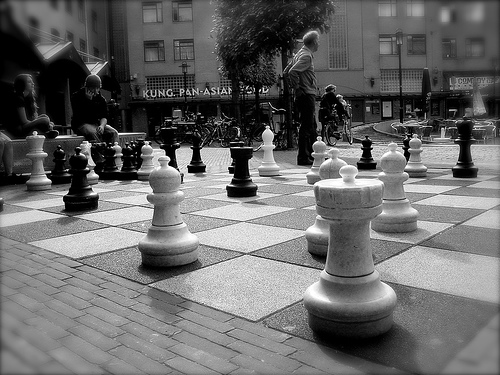
Amir used to play competitive chess (funnily enough, against a great school friend of mine, Igor Loza) and got quite good. He explains that when you begin learning how to play chess, the instructors would make you annotate the game, jotting down all of the moves you made during the contest. When the game was over, the instructors would sit down and walk through the game with him, blow-by-blow, questioning his strategy and ideas at each stage. This quickly developed Amir’s chess skills because it began highlighting where he was making common mistakes often, as well as making him more aware of the patterns that, when presented to him in a game, would cause him problems. This enabled him to eliminate these patterns earlier in games of chess, which left him playing to his strengths more often. As a result, he became very good, very quickly.

The key is to spot patterns in your actions as they emerge AND build an understanding of how you react to those patterns as they take shape. Annotating the game is just one way to do this, but a very powerful one at that. I look forward to giving it more of a go.

Trampoline videos now online

It’s with great pleasure that I’m able to write this blog post today and point everyone to the new Trampoline Vimeo Channel, on Vimeo. The last Trampoline was run in late October and many of the talks shared on the day still resonate with me now. Talks like Dan Donahoo speaking about Edge Theory, Peter Spence speaking about Intergenerational Learningand, one of my favourite sessions from the day, Matt Cashmore discussing the possibility of the first 1000 year old human having just been born.

Matthew Cashmore from Trampoline Melbourne on Vimeo.

We will be adding more video, from both Trampoline 1 and Trampoline 2, over the coming months. A big thanks to everyone that brought cameras to the events, and to Chris and James at Visionary Canary for helping us make this happen. Also, a massive thanks to Nathan at Inspire9 for hosting the videos on his server pre-vimeo.